Repeated sin can dull our awareness of its seriousness. This clip explores how we become accustomed to sin—and why God sending His Son reveals consequences we cannot afford to ignore.
Isaiah 53:5
17 mins
Why Did God Send His Son?
Why did God send His Son? Explore the seriousness of sin, why our efforts cannot remove it, and how Jesus Christ accomplished the work of salvation.
Message Summary
Q&A
Questions answered in this gospel message
Watch short video excerpts addressing some of the core questions from this message.
-
Question
01
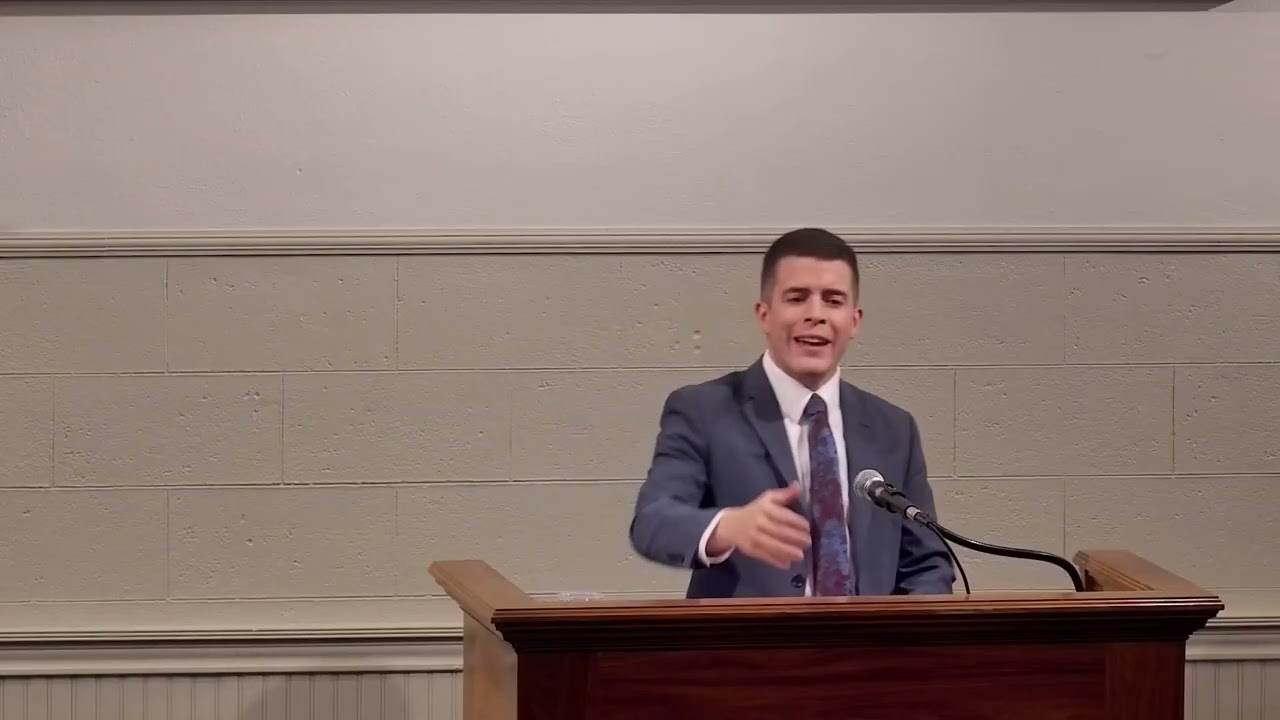
Why doesn’t sin bother us anymore?
Key Answer
Full Sermon Transcript
Trying to Appease God
A little illustration. Let’s imagine for a moment that perhaps a preacher was traveling through the wilderness or through some desert, perhaps a jungle. I can imagine him perhaps making his way through with his machete, making a path. He’s traveling. He’s just looking for people with whom to share this great truth that the Father has sent the Son to be the Saviour of the world.
And there on his trip, he finds a group of people. Perhaps they’ve never been in contact with exterior society. And there are these, perhaps we would say, tribal people, native people. And as is still the case in some places, I can imagine some of them perhaps might have an altar, or perhaps the bottom of a tree there, and they would pour out blood. Perhaps some of them would wound themselves, bruise themselves, cut themselves, and they’re offering something to the altar, to the tree.
And you might say, well, what’s going on here? What are these people doing? Well, you see, these people are trying to appease God. Now, they might not know God. In fact, if they’re acting in such a way, it shows that they do not know God.
Well, you know, we might look at such people, and perhaps we might have judgment in our own hearts towards such people. But these people have one thing that many of us lack in our society, in the West, as it’s oftentimes called. We think that we are so advanced, and perhaps in some areas we are much advanced, but in the spiritual realm we actually are far, far behind.
You know, these people, as I’ve just tried to picture, have a God-consciousness, for one. But secondly, they have a sense of sin. They have a sensitivity to sin and to their guilt, something that many of us don’t actually have in our culture. We’ve totally lost a sense of sin.
And I say that because perhaps you’ve been here for a couple of nights. You’ve heard the gospel before, and perhaps you hear that three-letter word quite often: sin, S-I-N. It’s that, quote, ugly word, sin. And you might think, why? Why are these preachers talking about sin so much? Well, it’s just because we have lost, for the most part, this sensitivity to sin. It’s not that we like to speak about sin.
And to go back to my imaginary illustration, if I was, say, the man who found these people, and they’re there trying to appease God, I wouldn’t even waste too much time speaking about sin. If they’re already conscious of their guilt, if they’re already conscious of a Creator, I might just come and tell them, “Hey, you don’t need to wound or bruise yourself. Listen, the Creator, the God of heaven, the Father sent the Son to be the Saviour of the world.”
And to quote the prophets, speaking of the Son, “He was wounded for our transgressions. He was bruised for our iniquities. The chastisement of our peace was upon him, and with his stripes we are healed.” The punishment that brings us peace was upon Him, and with His stripes we are healed.
And perhaps the people, ideally, would have understood: wow, there’s no need for me to wound myself, to bruise myself, to try to appease God. The Son, on my behalf, has appeased God. He has done a work that satisfies God for my sins. The people hopefully would have been saved just by understanding: it doesn’t depend on me, but it’s the Son of God who’s done it all.
Losing Our Sensitivity to Sin
You see, you and I oftentimes think that we’re all right. We have lost this sensitivity to sin. In fact, we might say that we’ve become sedated by sin. We’re so accustomed to it, we hardly bat an eye, as it were, hardly think twice.
You know, the Bible speaks; it gives quite illustrative language. It speaks of man who drinks iniquity like water. It describes man as people who drink iniquity like water. We think of water: something that we need, something that we crave, something that we can’t go too many days without. We always go back to it. We need it. We can’t function without it. We need water. And when we have water, it just goes down very easily, without any trouble.
And you know, God actually paints the picture for us. Just as we drink water physically, He paints the same image as far as sin. We go back to it. We gravitate to it. We’re not satisfied without it. We need it. Man drinks iniquity like water. And we’ve become so accustomed to it that, for the most part, we’ve lost sight of the consequences of sin.
Why the Father Sent the Son
And so why did the Father send the Son? What caused Him to come into this world? And it’s just that: the severity of sin. The fact that God looked upon the earth and He saw that the wickedness of man and the imagination of his heart was only evil continually.
We can be thankful that God was not unmoved by the state of man. We can be glad that God didn’t abandon us in the way that we were. He didn’t leave us to ourselves. He didn’t leave us in our sins. He didn’t leave us to perish. He’s eternal judgment for our sins. And be thankful that the Father sent the Son to be the Saviour of the world.
The fact that the Son came, the Lord Jesus Christ, the fact that He actually came into this world—I hope you believe that. I know you’ve heard that in the past. I hope to you it’s not just a nice story. I hope you don’t see the Bible as some fictional book that has some really good morals that I can then apply to my real life.
The Word of God is real. It’s true. There’s a real God, and He actually stepped into this creation in the person of the Lord Jesus Christ. And the fact that the Son of God came into this world has tremendous implications on your life, implications that cannot be overlooked. The fact that the Son of God came into this world has implications that you cannot afford to just ignore. They demand your utmost attention.
The Seriousness of Sin
The fact that the Son of God came just shows how serious sin is, that it took the intervention of the very Son of God. As I’ve said, in the society in which we live, as the Bible says, fools mock at sin. They make a mockery of sin. If they even believe there’s such a thing as sin or evil, they mock at it. They mock at the consequences of sin. “All these Christians telling me from the Bible that the wages of sin is death.” They mock at it. They laugh at it.
Well, you know, sin is very serious. And the Bible says that fools mock at sin. I hope there’s nobody here playing, as it were, trifling with sin. There’s nothing more serious. There’s nothing more serious than the issue of our sins. Sin has cost us our lives. We might say, spiritually speaking, because of our sins, we’re dead. We’re dead to God. We’re not in a relationship with God. Life has been severed. The light has been turned off because of sin.
Sin is very serious. There are a lot of issues in our world. We won’t deny it. Many people are suffering, and we won’t belittle it. People are going through things that I can’t even begin to empathize with. I don’t understand what sometimes people are going through, and these are real difficulties. And yet, despite the hardships and the troubles of this world, the number one problem, the most serious thing in our world, is the problem of sin. And that’s why God sent a Saviour.
If politics was the biggest issue, I suppose He could have sent a governor. If economics were the biggest issue, I suppose He could have sent someone who manages funds, a financial advisor. If marital issues were the main issues in our society, He could have sent a counsellor. I know that some of you know Scripture, and some of these titles are actually attributed to the Lord Jesus. But the main problem requires the main purpose for the Son coming into this world. The Father has sent the Son as Saviour, as Saviour of the world, as Saviour from sins.
Sent to Save the World
And you know, it not only shows the gravity of sin. The Bible actually says that God, sending His Son in the likeness of sinful flesh, for sin, condemned sin in the flesh. That means the Lord Jesus came as a man. He came in the likeness of sinful flesh, meaning He didn’t have any sin. He came as a real man. And why did He come? I just said it: for sin. That there upon the cross, sin might be condemned, not in us, in Him. Condemned sin in the flesh. Sin is a serious thing. That Christ came into the world is testament to that reality.
But He also came for salvation. Scripture says, “For God sent not his Son into the world to condemn the world; but that the world through him might be saved.” God has provided a salvation through a Saviour, through whom you can be saved, even tonight, from your sins, from condemnation.
You say, “Well, if He came not to condemn, I suppose I’m not condemned.” Well, actually, the Bible says the reason why the Lord didn’t come to condemn the world is because the world is condemned already because of our sins. But God in grace moved to provide a Saviour, a Saviour by whom you can be saved.
Why Our Efforts Cannot Take Away Sin
And this is something that you must grasp tonight: this salvation does not depend in any way, shape or form upon you. It doesn’t depend upon your performance. You say, “Brendon, I’ve heard that in nights past. You keep saying the same thing.” Well, you haven’t believed it yet. People attend meetings. We tell them, “It’s not by works.” And we talk to them: “Well, I’m trying.” No, no, no. Stop trying tonight, would you? It doesn’t depend upon you.
You know, there is only one religion that God has ever given to mankind, one religious system: Judaism, given to the Jews. Initially, they had a temple, sort of a tent compound, and then eventually they had a temple in Jerusalem. And they had a whole system linked with that temple. You know what God says, what the Bible says? Everything linked with the temple, linked with, you might say, that religion, God says could not take away sins.
And if the only religion that God has ever given to man could not take away sin, you say, why was it given in the first place? It was really all pointing to the Lord Jesus. You might say it was all an object lesson speaking of the Lord Jesus and the sacrifice that He would perform. We need to ask ourselves: if the one religious system that God has given to man cannot take away sin, why do we think that man-made religion and systems will take away sins? It cannot.
All that the Jews had—they had priests, priests with beautiful gowns. They offered incense. They lit up candles. Sounds familiar. They would offer sacrifices. They would offer up prayers. They would sing, have a choir, if you will. God says all these things cannot take away sin. It’s a picture that our efforts could never take away sin.
Simply, if they could, if you and I could do something that could remove our sins, then this wouldn’t have happened: the Father sending the Son to be the Saviour of the world. If there’s something that you think that you must do, you’re saying, “I don’t actually need Christ.” And Paul says, if we could get to heaven by our own merits—I’m paraphrasing—he said Christ died in vain.
The Saviour Has Accomplished the Work
Now, the Father sent the Son to be the Saviour of the world, and the work that saves, He accomplished it completely Himself. He doesn’t need your contribution. He doesn’t need you to add anything to it. “That the world through him might be saved.” That’s what the Bible says. The world, the Saviour of the world, that you through Him might be saved. It doesn’t say through you, but through Him might be saved. And a Saviour saves.
And the work has been accomplished. What God required for sin, payment for sin, judgment for sin, what appeased God—remember those poor people trying to appease God by themselves, trying to please God by themselves—the Lord Jesus has taken in hand. He was the One who really was, as we saw in a past night, became accountable for our sins to God. There at the cross, He died for our sins on our behalf. And there He’s provided a full salvation. And in Him, in what He has done for you, you can be saved.
Why did the Father send the Son? Because of the seriousness of sin. To provide a Saviour for sin. And thank the Lord tonight that indeed the Father has sent the Son to be the Saviour of the world.
Scripture quotations outside the historical sermon transcript use the New King James Version®. Copyright © 1982 by Thomas Nelson. Used by permission. All rights reserved. . The transcript preserves the wording used by the speaker.
Key scripture
But He was wounded for our transgressions, He was bruised for our iniquities; The chastisement for our peace was upon Him, And by His stripes we are healed.
Isaiah 53:5