
Good evening, and thank you again for coming tonight. It is very encouraging to see you here on a Monday night. Let me remind you of the nights remaining in this brief series — God willing, Tuesday through Friday, the gospel will be preached here each evening at 7 o’clock. We’ll continue looking at these personages and the impact that the Bible and Christianity had on their lives, and consequently the impact that their lives had on our world.
When it comes to gauging the impact of these people, it’s easy to see what the inventors and scientists have accomplished — every time you start your car, send an email, plug an appliance into a wall socket, or, as we noted last night, have surgery at a hospital, you are indebted to these brilliant men and women. The missionaries are responsible for saving countless lives from pagan deaths and rituals, and their translation of languages that would otherwise have remained unknown has been a tremendous blessing to peoples all over the world. And of course, these preachers have seen untold lives changed; the martyrs changed the course of nations.
But it’s kind of hard to quantify the impact of the musicians, and we’re going to be looking at one of those musicians tonight. I don’t know how you would somehow gauge or add up the acts of selfless service and the ennobling, charitable, spiritual, philanthropic, or heroic acts that have occurred because someone was inspired by the music or words of one of these people. In fact, the longest book in God’s Bible is a book that is meant to be sung — the Psalms. So God understood how important music was, and the words that go along with it.
Tonight we’ll be looking at this remarkable woman, Fanny Crosby, and the impact that she had on the music world and on the world in general. Before reading the Scriptures, we’re going to ask God’s blessing. Shall we pray?
Prayer & Scripture Reading: John 5:24
Father, we embrace the opportunity to draw near to Thee and to give thanks for Thy beloved Son, to open the Word of God and to be able once more to tell an audience of men and women who are journeying through this life to eternity that there is a home in heaven available, there is a Saviour who loves them, there is a God who wishes their well-being and their eternal blessing. It is a great privilege to be able to do this, and we ask for Thy blessing on Thy Word as we read it together, giving our thanks in the name of the Lord Jesus. Amen.
I’d like to read with you in John’s biography of the Lord Jesus — we’re going to read in chapter 5. If you have any trouble finding John chapter 5, it’s the fourth book of the New Testament, and I’m sure someone near you will help you locate it.
“Most assuredly, I say to you, he who hears My word and believes in Him who sent Me has everlasting life, and shall not come into judgment, but has passed from death into life.” (John 5:24, NKJV)
Do you know any religion in the world that assures you that you can have everlasting life right now? That’s what the Lord Jesus is saying: he that hears His word and believes on Him that sent Him has everlasting life, and shall not come into condemnation, but has passed from death unto life.
Fanny Crosby’s Forgotten Fame
In our postmodern society, with its decreasing knowledge of the Bible, I think it’s difficult for us to grasp how well known many evangelists, missionaries, and hymn writers once were to the general public. Take, for example, the death of Charles Spurgeon, the English preacher — his funeral procession rivalled a royal burial. Thousands upon thousands turned out because this preacher had died. Or think of the return of Adoniram Judson, the missionary who left Massachusetts and went to Burma. When he came back, it was like a rock star returning to the United States — people had read reports of what it was like in Burma, and they thronged to meet him.
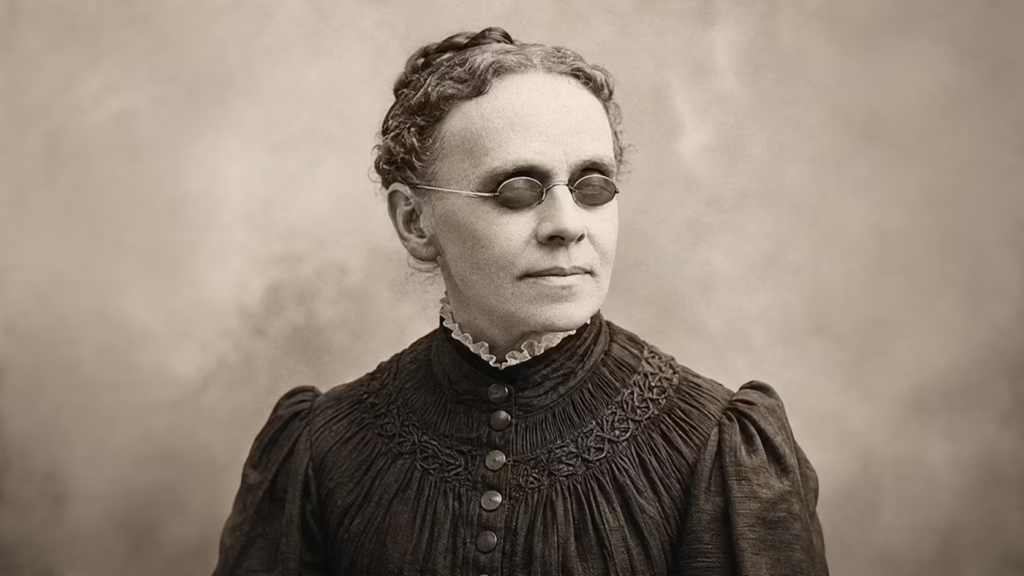
Similarly, the hymns of Fanny Crosby had worked their way into the general consciousness of her day. In her book Memories of Eighty Years, she tells about a man in Hyde Park, London, who was claiming to be the Messiah. He drew people around him and preached to them about himself, doing this in public for weeks. One night, as he was preaching, a small band of Salvation Army soldiers passed by singing one of Fanny Crosby’s songs: “I shall know Him, I shall know Him, as redeemed by His side I stand; I shall know Him, I shall know Him, by the print of the nails in His hand.” The crowd around the man knew the words and joined in singing. Then somebody spoke up about the man claiming to be the Messiah: “Check his hands — look for the nail prints.” Of course, they weren’t there, and Fanny Crosby describes people turning away from the man who was falsely claiming to be the Messiah.
Just think about that for a moment. If that happened today, do you think the crowd would know the words to a Fanny Crosby hymn? The Salvation Army might not even know it. Things have changed so drastically. But in her day, Fanny Crosby and her hymns, along with many other Christian authors and their hymns, were well known to people all over the world.
One biographer wrote that in her day she was considered by most people to be the greatest person in America — as Johann Strauss reigned in Vienna as the Waltz King, and John Philip Sousa in Washington as the March King, so Fanny Crosby reigned in New York in the latter nineteenth and early twentieth century as the Queen of Hymns. In February 1892, one writer described her this way:
“Fanny Crosby of New York, the hymn writer whose sacred songs are sung wherever the English language is spoken. For twenty years she has been employed by the firm of Biglow and Main, to whom she supplies a certain number of hymns every week, and she is so prolific a hymn writer that during this engagement she is said to have composed nearly 3,000 hymns. She has been a close student of the Bible and a reader of standard authors, and she considers her wonderful memory her greatest blessing. She memorizes her hymns before beginning to dictate them, and sometimes four of them are prepared before one is transferred to paper. Miss Crosby is a slender woman, somewhat below the average stature, with an animated and happy face, and now, at the age of nearly seventy-two years, this energetic woman, whose cheerful spirit sheds a sweet air of peace and happiness around her, pursues her career with undiminished vigour.”
And Lewis Rodenberg, in his journal Outlook for the Blind, wrote this in December 1931: “All over the country, and one might say all over the world, the hymns of Fanny Crosby are singing themselves into the hearts and souls of the people. They will do this as long as our civilization lasts.”
Blind from Six Weeks Old
She was born March 24, 1820. Her name was Frances Jane Crosby. She had normal vision at birth, but at six weeks old she suffered an eye inflammation. The family’s regular doctor was unavailable, so they sought help from a man who claimed to be medically qualified. He put a poultice on her eyes that left her infant eyes scarred, and the so-called doctor left town not long after. Fanny’s father died shortly afterward, and her young mother had to seek domestic work in a nearby town. So this blind daughter was placed in the care of her own grandmother, Eunice.
Eunice was resolved that Fanny would not grow up dependent and helpless. She educated her about the world around her, and — this is an incredible thing — she helped Fanny memorize great amounts of the Bible and other books. It seems unbelievable, at least to me, because I can hardly remember what I had for supper last night. By the time Fanny was ten, she could recite the first four books of the Old Testament and the four Gospels. She knew by heart Genesis, Exodus, Leviticus, and Numbers — and I don’t mean just the titles, she knew the books themselves — as well as Matthew, Mark, Luke, and John. She could also repeat poems almost without number. She sometimes compared her mind to a writing desk with little compartments filled with information, readily available. I think of my mind like that too — but the drawers just don’t open.
When her mother told her that Milton, one of the world’s finest poets, had also been blind, Fanny memorized his poems as her mother read them to her. So while she was blind, there were other remarkable things about her as well.
School for the Blind & Meeting a Future President
When she was fourteen, her mother heard about the newly opened New York Institute for the Blind, and in 1835 Fanny enrolled there — finally finding what she had been praying for: a chance to learn among people who could teach her all that she wanted to learn.
She learned things so quickly and so completely that even years later she could recite the entire contents of her grammar textbook. The way they taught at that school, the teacher would read a text aloud, and the children were expected to grasp it well enough to repeat it back. She loved everything except mathematics, and — true to form — expressed her feelings about it in verse, joking that the very word “arithmetic” made her sick.
Fanny continued to demonstrate her poetic talent and was frequently asked to compose verses for special occasions. In later life she met a number of very famous people — the singer Jenny Lind, the political figure Henry Clay, General Winfield Scott, and a number of U.S. presidents. Most interesting among her acquaintances was President Grover Cleveland. Long before he became president, when he was just sixteen, he was employed in the modest position of secretary to that institution where Fanny worked. The head teacher — Grover Cleveland’s older brother — asked Fanny to keep an eye (sorry for the pun) on Grover, because he was taking their father’s recent death very hard. That was the beginning of a lifelong friendship between Fanny Crosby and this man who would one day become president of the United States.
Fanny’s Conversion in 1850
Though she had always been a religious person, it was not until she was almost thirty-one, in 1850, that she was saved. It was on November 20th that she trusted Christ. That day she’d been troubled by a dream, and she was attending gospel meetings at a Methodist church in New York City. Sure enough, it was the truth in a hymn that God used to reach her — a hymn written by Isaac Watts that we often sing right in this room: “Alas! and did my Saviour bleed, and did my Sovereign die? Would He devote that sacred head for such a worm as I?” The great truth dawned on Fanny that Christ loved her and died for her on the cross.
As I said, she had a marvellous memory, which enabled her to accomplish great things. On one occasion she was asked to write forty poems. She thought each poem out carefully in her mind, and when they were all finished, she quoted them one by one to somebody who could transcribe them. She explained her method this way: “I never undertake a hymn without first asking the good Lord to be my inspiration in the work I am about to do.” She would pray and think it over until she was in the right mood, and at times she would say she had as many as forty different songs stored away in her mind at once.
Writing “Safe in the Arms of Jesus”
Many of her hymns were inspired by some specific experience. One day her close friend William Doane arrived at her house with a melody in mind. He sat down at the piano — he was on his way to catch a train and didn’t have a lot of time, but he needed a poem that would fit the tune. As soon as he played it for her, she clapped her hands together and said, “That says, ‘Safe in the arms of Jesus.’” She wrote the hymn Safe in the Arms of Jesus, and it was immediately popular, eventually becoming a worldwide comfort, particularly for those who had lost a child.
One of her hymns meant so much to her that she called it her “heart song.” It’s what we know today as Someday the Silver Cord Will Break. It was so personal that for years she kept it entirely to herself — nobody knew that poem existed. But one day, at a Bible conference in Northfield, Massachusetts, D. L. Moody asked her to give a personal testimony. At first she hesitated, then she quietly rose and said, “There’s one hymn I have written which has never been published. I call it my soul’s poem. Sometime when I am troubled I repeat it to myself, for it brings comfort to my heart.” Then she recited the words:
“Someday the silver cord will break, and I no more as now shall sing; but oh, the joy when I shall wake within the palace of the King! And I shall see Him face to face, and tell the story — saved by grace.”
Remember, this is a blind poet writing about seeing.
If you stacked fifteen hymnbooks one on top of another, that’s roughly the number of hymns Fanny Crosby wrote in her lifetime. Many of those have been forgotten today, but a large number remain favourites all over the world. In her most prolific years, so many of her hymns entered the hymnals that, like many productive writers, she used various pseudonyms so publishers wouldn’t fill an entire hymnbook with nothing but Crosby songs. She used nearly two hundred pen names — among them Julia Sterling, Frank Gould, Carrie M. Wilson, Lyman Cuyler, Victoria Stewart, Mrs. Marian, and Ella Dale. She made up the names because she didn’t want people to think only about her.
Fanny’s Later Years and Death
When she was eighty-three years old, she said, “I am content with what I know of life through the four senses I possess, which are practically unimpaired.” At eighty-six, she wrote, “If I were given a little more time in which to do it, I could take down from the shelves of my memory hundreds, if not thousands, of hymns that I have written in the sixty years during which I have been praising my Redeemer through this medium of song.”
In her nineties she wrote something worth writing down — and there are some older folks here tonight, so take note, because this is a wonderful attitude to have: “I have made up my mind never to become a disagreeable old woman, and always to take cheer and sunshine with me. And I have the great consolation of knowing that I will never become a disagreeable old woman.”
In her autobiography she wrote, “It seemed intended by the blessed providence of God that I should be blind all my life, and I thank Him for that.” The doctor who destroyed her sight apparently never forgave himself and moved away from the area, but Fanny Crosby held no ill will toward him. She said, “If I could meet him now, I would say, thank you, thank you, thank you, over and over again — thank you for making me blind.” She claimed that even if her sight could be restored, she wouldn’t want it, because she believed her blindness was God’s gift to her, freeing her to write songs for His glory. As she put it: “I could not have written thousands of hymns if I had been hindered by the distractions of seeing all the interesting and beautiful objects that would have been presented to my notice.”
On February 11, 1915, she dictated a letter of sympathy in verse to a neighbouring family on the death of their child, assuring them that their daughter was “safe in the arms of Jesus.” Later that same night, she slipped into the presence of the Lord she had served through her verses and her life. Warren Wiersbe wrote about that moment: for the first time, she could see — and best of all, she could see her Saviour.
Have you ever noticed how often she wrote about seeing in her lyrics? Watch for those references the next time you sing a Fanny Crosby song. Perhaps the best known of all is the chorus of Saved by Grace: “And I shall see Him face to face, and tell the story — saved by grace.”
A Wonderful Saviour: Isaiah’s Titles for Christ
So in the remaining moments of the meeting, I want to take her words and talk to you about the truth behind some of the things she wrote. One of her hymns says, “A wonderful Saviour is Jesus my Lord, a wonderful Saviour to me.” So I want to tell you about Fanny Crosby’s wonderful Saviour.
In Isaiah chapter 9, the prophet gives us titles for the Lord Jesus — you’ve probably heard this sung, perhaps at Christmas time if no other time. Isaiah wrote: “His name shall be called Wonderful, Counselor, Mighty God, Everlasting Father, Prince of Peace” (Isaiah 9:6). That first title, “Wonderful,” comes from a Hebrew root word meaning to set apart, to separate, to distinguish. The Lord Jesus is set apart from all others.
Just think about the wonderful words He spoke. I don’t just mean the manner in which He spoke — that must have been absolutely wonderful — but in all of history, no one ever said what the Lord Jesus said. There are loving words He spoke that even His enemies had to admit would make the world an incomparably better place if mankind lived by them. Just take His parable of the Good Samaritan. I travel around a bit, and I see the same thing in place after place — a hospital called Good Samaritan Hospital, or Bethany, or Bethesda. That parable alone has resulted in the founding of countless hospitals and charitable organizations. The man who started the Red Cross started it because of the influence of the Bible in his life.
Part of a larger series
This message is part of The Impact of the Bible & Christianity on World History, exploring people whose Christian convictions shaped their lives and influence.
The historian Paul Johnson once quoted Pablo Picasso scoffing at the idea of one person giving money or help to a needy person. Picasso reportedly said, “I’m afraid you’ve got it wrong — we are socialists, we don’t pretend to be Christians.” He knew that what Christians are famous for is helping others, and he knew exactly where that comes from: the teachings of the Lord Jesus. His words are living words.
His Words Are Living Words
He said, “The words that I speak unto you, they are spirit, and they are life.” Sometimes you hear somebody’s statements described as “words to live by” — but that phrase assumes you’re already living, and these words will simply help guide your life, help you in decision-making, help shape your character. But the words of the Lord Jesus are not merely words to live by — they’re words that give life. They’re words to live on.
“For God So Loved the World” — John 3:16
Listen to what He said in John chapter 3: “For God so loved the world that He gave His only begotten Son, that whoever believes in Him should not perish but have everlasting life” (John 3:16). A Scottish lad named Fred Stanley Arnot heard those words, trusted Christ, was saved, and went to Africa to preach the gospel.
“I Will in No Wise Cast Out” — John 6:37 & 6:47
Listen to what He said in John 6:37: “Him that cometh to Me I will in no wise cast out.” A Scottish boy named Robert Annan, in a place called Dundee, heard those words and his life was revolutionized. In John 6:47 the Lord Jesus said, “Verily, verily, I say unto you, he that believeth on Me hath everlasting life.” An Englishman named Alexander Marshall heard those words, trusted Christ, and became a gospel preacher whose writings have been used in the salvation of thousands of people.
“Let These Go Their Way” — John 18:8
In John 18:8, in the Garden of Gethsemane, the Lord Jesus said to those who came to arrest Him, “If therefore ye seek Me, let these go their way.” He was actually standing between an armed mob and eleven terrified disciples, and He said, “If you’ve come for Me, let them go.” Eleven frightened disciples disappeared into the darkness of the garden while the courageous Son of God stretched out His hands to be bound and led away like a lamb to the slaughter. Years later, a man named Donald Ross, struggling to find salvation, came across those words and realized that’s exactly what happened, not just in the garden, but at Calvary: He took my place so that I could go free. Donald Ross trusted Christ and became a mighty preacher of the gospel.
“It Is Finished” — John 19:30
In John 19:30, on the cross, the Lord Jesus said, “It is finished,” and bowed His head and dismissed His spirit. Years later, a young Englishman named James Hudson Taylor read those words — the finished work of Christ — and trusted Christ. Missionary James Hudson Taylor went on to China and had an incredible impact on that nation, seeing thousands of Chinese people brought to the Lord Jesus. His words are living words.
A Peruvian Headhunter and the Tower of Light
Years ago, at a World’s Fair in New York City, there was a ceremony in 1964 called the Lighting of the Tower of Light, where a man was going to throw a switch and lights would be seen for hundreds of miles. The man who threw that switch was a Peruvian headhunter — a tribal chief in Peru. Around his hut had once stood poles displaying the heads of the chiefs he had killed in battle. He was a brutal, violent, vicious man.
Two women took pens, paper, and the most powerful weapon in the world, and went into the village where that chief lived. The weapon they carried was the Bible. God must have worked in the heart of that chief, because instead of murdering them, he favoured them — he listened to them, he talked with them. They learned the language, began translating it, and talked to the chief about the Bible, about the gospel, about the Lord Jesus. Finally, the power of God’s Word in the gospel reached that once-brutal man and saved him. That’s the man who threw the switch at the New York World’s Fair. What changed his life? Words. An army couldn’t have won that battle — two women went in armed with nothing but the Bible. But the words of the Lord Jesus are living words.
His Words Are Lasting Words
His words are lasting words. Nobody else could say this with any authority or certainty, but the Lord Jesus said, “Heaven and earth will pass away, but My words will not pass away.” His words have outlived every would-be pole-bearer, atheist, cult leader, and Bible critic — and as far as our stay on earth is concerned, they’re going to outlive you and me. They’re going to outlive the cosmos.
Church teaching changes. Religious thinking changes. Standards shift, and opinions get molded and massaged according to what people think in a given day. But the Bible remains the same. His Word endures. What I trusted as a teenager in 1966 says the same thing to me in 2024, and when I’m long gone, it will say the same thing in the year 3024 — and forever.
The Ultimate Value of Your Soul
Now, it’s very easy to have a hazy, nebulous idea that we all accept the words of Jesus. So I’m going to put you to the test, if that’s okay — I’m going to give you some of His words, and I want to ask whether you actually believe what He said.
He told us about the ultimate value of a human being. Here’s how He put it: “What shall it profit a man if he shall gain the whole world, and lose his own soul?” I find, at least as far as many people are concerned, that people live as if they were nothing more than bodies — when in fact they are souls who have a body — and they hardly ever think about eternity. They live as if they’re going to stay here permanently, when in fact we are here for a comparatively short time and in eternity forever. So the Lord Jesus said it would profit you nothing to gain absolutely everything possible to acquire, if you yourself missed heaven. Do you believe His words?
A man named Glen Adsit was a missionary in China. In the 1940s, he was placed under house arrest by the Communists, who had to decide what to do with him. They had already murdered a number of other missionaries, but they hadn’t yet decided the fate of Glen Adsit, his wife, and their children. Finally they came to him and said: you may leave, and you may take 200 pounds with you — 200 pounds between the two of you, that’s it. They had some days to pack, but that was the limit.
There was a bit of arguing between husband and wife — she wanted to take souvenirs and pots and pans, he wanted to take books and other things. They had to give and take, carefully weighing the vases, the toys, the typewriter, everything they packed, to make sure the total came in under 200 pounds.
The day they were to leave, the soldiers came and asked if they were ready. “Yes,” Glenn said, “we’re ready.” “Did you weigh everything?” “Yes, nothing over 200 pounds, all our bags.” “Did you weigh the kids?” Glenn said, “Excuse me?” “200 pounds — that’s all you can take with you. Did you weigh your children?”
Do you think, at that moment, they cared about the books, the typewriter, the vases, the trinkets? Everything else was forgotten while they weighed the children. Once the weight of their children was settled, then they could decide how much else there was room for. First things first — nothing they owned was more important than their children.
Nothing you own is more important than you yourself, and where you are going to spend eternity. That’s what the Lord Jesus says. Do you believe Him? There came a point in my own life where I believed Him, and I realized that the most important thing was my salvation.
The Most Important Decision You Will Ever Make
That leads right into His next point — He told us about ultimate importance. He said that your salvation is the most important thing there is: “Strive to enter in at the strait gate.” Many people approach the subject of salvation thoughtlessly. They don’t give much thought to it — they let their ideas of how you’re saved, or how you get to heaven, simply be shaped by whatever they’ve heard, whatever a church happens to say, or their own personal preferences. They’ve never actually stopped to ask: what does the God of heaven say? How do I get into heaven, according to what God says?
The Hymn Books at Customs
I was coming into your country once, back in 1979. We had hymn books in the back of the car. The late Mr. Jim Smith was driving, and we got to the customs official. “What are the boxes in the back?” he asked. Mr. Smith said, “They’re hymn books.” “You can’t take them.” Mr. Smith tried to explain — we’re here for gospel meetings, we were just going to use them in the meetings. “Can’t take them,” the official said. “You could take them if you were going to sell them — but you can’t take them just to give away.” Mr. Smith tried to explain that he’d gone through enough trouble getting the books printed and had no intention of selling them, but when we pulled away from that customs station, those boxes of hymn books stayed behind in a locker.
You know why? Because it wasn’t our country. We don’t tell a customs officer what we’re going to bring in — he tells us. Heaven is God’s country. We don’t tell Him how we’re going to get there. We don’t say to Him, “Well, I’ve been baptized, that should be okay,” or “I’ve given quite a bit of money to the church,” or “I’m sincere — no matter what I believe or don’t believe, I’m very sincere, and that should get me into heaven.” No — we don’t tell Him. We need to hear what He says, because it’s His heaven, and He says, “You must be born again.”
So the question tonight is: do you believe His word? Do you believe that your soul, your eternal destiny, is the most important thing in your life? Do you realize — and do you believe — that salvation is the number one priority?
A Rebar Accident
I have a friend in Maine, known to some here, named Mike Thompson — Mike could talk to a cigar store Indian, he’s that outgoing. He was talking to a friend about the Lord Jesus, telling him he needed to be saved. Not long after that, this man was on a construction site and — this is a bit crude to describe, but it happened — he was pierced by a piece of rebar. Picture a thin iron or steel rod going straight through his back and out the front of his stomach. He told Mike afterward, “When I looked down and saw that, I tried to think of everything you’d told me — everything about heaven, about salvation, about Christ, everything.” Then he said a funny thing: when the ambulance came and pulled the rebar out, and they told him none of his vital organs had been hit, he said he pretty much forgot everything Mike had told him.
So when he thought he was going to die, he was desperately trying to recall how to be saved — and once it seemed like everything was going to be okay, it was hardly on his mind anymore. There are a lot of people like that. I hope there’s nobody like that here tonight. I hope you’re not carelessly, thoughtlessly drifting through life, imagining that one day everything will just be okay, without ever finding out what God actually says you need if you’re going to be in His heaven.
It’s the Lord Jesus — the one who told us so much about the love of God — who also told us about the ultimate peril: that a person could lose everything, for eternity. He told us about a man who built his house on sand instead of on the rock, the foundation of His words and His work. As soon as a storm comes — like death — the sandy foundation gives way, and the man loses everything. He reminded us about the terrible danger that a person can live, die, and go into eternity without Christ — and that human being will lose everything: hope, joy, peace, companionship, friendship, love, life, light — gone. Do you believe His words?
His Words of Ultimate Assurance
Do you believe what He said? He’s a wonderful Saviour, and He spoke wonderful words — and part of the wonderful words He spoke have to do with ultimate assurance. Listen again to His words: “Verily, verily, I say unto you…”
Let me stop a moment. Have you ever noticed, tonight or on other nights when you’ve come to the gospel hall, that generally when somebody prays, they end the prayer with “Amen”? “Amen” literally means “let it be this way.” For instance, I prayed today for a man who’s very ill. When I finished praying, I said “Amen” — why? Because I can’t make him better. I’m saying to God, “If it’s Your will, let it be this way.” So at the end of my prayer, after my requests, I say “Amen,” effectively asking God, “According to Your will, let it be this way.”
But the Lord Jesus takes that word “amen” and moves it — not to the end of His statements, but to the beginning. Again and again He says, “Amen, amen, I say to you…” Do you know what that means? I say “amen” at the end of a prayer because I’m reverently saying to God, “let it be this way.” The Lord Jesus moves it to the beginning of His statements because He is saying, “This is how it’s going to be.” That’s the voice of ultimate authority. This is how it’s going to be: “He that heareth My word, and believeth on Him that sent Me, hath everlasting life.”
Do you have everlasting life tonight? These are wonderful words. Do you believe the words of the Lord Jesus?
A Story from Halifax: Leading a Friend to Christ
There are people in the meeting tonight who remind me of a wonderful experience I had in a place called Halifax. My daughter had a very close friend — in fact, she was a friend of our whole family, and I loved her dearly. She came down to stay with us at a Christian convention, a weekend of meetings. She wasn’t saved, and although I had preached to her many, many times, I noticed that particular weekend that something seemed different about her.
So I said to my daughter, “Something’s going on. What do you think about inviting her to come with us for the week?” I was going to Halifax for a week of ministry meetings — not gospel meetings this time, but teaching for Christians. I said, “It’ll keep her among the Christians, keep her where she has questions she can ask.” So my daughter invited her; she got in touch with her work, found out she could get the time off, and she came with us for the week.
The Halifax Christians couldn’t have been kinder. They embraced her just as if she were my own daughter — because that’s how they treated my daughter too. Just the essence of friendliness.
Near the end of the week, maybe Thursday, I was the only one with a car, and some of the group needed to go to the store, so I went to pick her up. She was in the back seat of my car, and as we pulled into the parking lot and I turned off the engine, I said to her, “You know, I don’t want to press you, but — is there something going on?”
It was like a tap opening — like a dam breaking. She said, “Yes. I thought I got saved the other day, but I don’t know — everybody here has been so kind to me, I can’t believe how kind the Christians have been, and I just want what they have. The other night I thought I got salvation, but it was just so simple, I don’t know…”
Needless to say, we didn’t go to the store. We turned around and drove back to the apartment where my daughter and the other women were staying. We got the Bible out and turned to John 5:24, and she read the words: “Verily, verily, I say unto you, he that heareth My word, and believeth on Him that sent Me, hath everlasting life.”
I said to her, “Now, those three things — the Lord Jesus has brought them together, and you can’t separate them. You can hear His word, not believe it, and not have everlasting life. But you cannot hear what He says, believe what He says, and not have everlasting life.”
She actually scared me a little — she shut the Bible and said, “That’s it.” She said, “That’s exactly what I saw the other night. But I just thought it can’t be that easy, because all I saw was that Jesus died for me, and I just trusted Him as my Saviour. I didn’t feel anything or see anything, but — that’s exactly it. I just needed to see it in black and white.” She said, “There it is: ‘He that heareth My word, and believeth on Him that sent Me, hath everlasting life.’”
Do You Believe Him? A Final Appeal
Now my time is gone — I have no time to tell you about her hymn Blessed Assurance, or about the home she sang about going to. But I do want, with all my heart, to commend to you my wonderful Saviour. There aren’t many things in life, at least as far as I’m concerned, that I could recommend to you unreservedly, wholeheartedly. We all have different tastes — I could tell you a restaurant was absolutely fantastic, and you might go and say it was the worst meal you ever had. We have so many different tastes and preferences, and we’re all different. But here is something that with all my heart I can recommend to you: this wonderful Saviour.
He’s the best of friends. He’s the kindest of masters. He’s the closest of friends. He is the best person you could have in your life. He’s the only one to have when you come to die — He’s the one who will be with you every step of the way. If you trust Him, He will be with you through death itself, and He will welcome you to His home — if you will trust this wonderful Saviour tonight.
Historical Sources & Further Reading
This page is a transcript of a spoken gospel message rather than a formal historical biography. Historical details concerning Fanny Crosby have been retained as presented by the speaker while being checked, where practical, against primary and reputable secondary sources. Some incidents in Crosby’s life have been retold in varying forms over the years; the sources below are provided for readers who would like to explore her life, conversion, hymn writing, and historical setting in greater depth.
- Fanny J. Crosby, Memories of Eighty Years (1906). Crosby’s own account of her childhood, education at the New York Institution for the Blind, friendships, Christian experience, work among missions, and the stories behind many of her hymns. Her account includes her conversion on November 20, 1850, during the singing of Isaac Watts’ “Alas! and Did My Saviour Bleed?” Read Memories of Eighty Years at the Internet Archive
- Fanny J. Crosby, Fanny Crosby’s Life-Story (1903). An earlier autobiographical account of Crosby’s life, published while she was still actively speaking and writing. It provides another important primary source for her childhood, blindness, education, Christian faith, and public life. Read Fanny Crosby’s Life-Story at the Internet Archive
- Edith L. Blumhofer, Her Heart Can See: The Life and Hymns of Fanny J. Crosby (Eerdmans, 2005). A modern scholarly biography based extensively on primary sources, including thousands of unpublished Crosby manuscripts. Blumhofer examines both Crosby’s well-known hymn writing and the wider historical context of her life, including her friendships, charitable work, and involvement in nineteenth-century American evangelicalism. Learn more from Eerdmans
- Hymnology Archive — Fanny Crosby. A research-oriented collection of primary sources, historical biographical material, hymnological references, and links to digitized editions of Crosby’s writings and hymns. Explore the Fanny Crosby resources at Hymnology Archive
- Hymnary.org — Fanny Crosby. A reference database for hymn texts, authors, composers, hymnals, publication history, and related information. It provides a useful index for tracing Crosby’s extensive body of hymns and the hymnals in which they have appeared. View Fanny Crosby’s author record at Hymnary.org