

I was asked by Phil about a month ago to give my testimony. So just for clarification, I looked up what a testimony actually is. According to the dictionary, it’s a statement or declaration about something you witness, experience, or believe to be true. In a Christian context, it’s pretty much how someone came to know the Lord Jesus Christ and accepted that He died for their sins. In other words, it’s how I came to know Jesus Christ as my Saviour — how I take Him as my Redeemer, and look up to Him.
Growing Up Religious, Not Believing
A Nominal Catholic Home in Ecuador
I was born in Ecuador and grew up in a fairly normal family. I moved to Canada about three years ago. Growing up, I went to a Catholic school, so there was always some kind of Mass or sermon around. But my family weren’t believers at all — we’d go to church occasionally, maybe once a year, if that. The country itself was pretty much the same way: baptism as a baby, then first communion, then confirmation — ceremonies you just do because they’re tradition, not because you believe anything behind them.
I actually never believed in God or paid much attention to it. It was just another subject at school, another box to check. But at the same time, I’d be a bit of a hypocrite about it — I’d say this doesn’t exist, but then when something bad happened, or I needed something to happen, I’d use God as my trump card. I’d pray and think, “okay, this will fix it.” Sometimes it was just coincidence and it worked out. But most of the time it didn’t help at all — life just continued. Nothing happened.
The Knock of the Jehovah’s Witnesses
Around the age of 13, my grandma and my mom had someone knock on their door — it turned out to be Jehovah’s Witnesses. My mom and grandma started going to their meetings, and I just wanted to spend time with them, so I’d go along occasionally. Then one of them wanted to study the Bible and some pamphlets with me one-on-one. I did it once, and she said she’d come back the next week at the same time. I said sure — and then every time she came back, I’d hide in my room and tell my grandma to say I wasn’t there, or pretend I’d died or something. I avoided it at all costs.
A New Country, A New Family
A Chaotic Move to Canada
Life continued like that until I was about 18. On October 3rd, 2021, I made the decision to move to Canada for a better future. It was a pretty crazy decision at the time, but it worked out.
The story of how I actually got here was wild, partly because of COVID. I had to be at my college by a certain time, but I didn’t have a place to stay. I booked my flight less than 23 hours before I left and arrived in Canada, if that gives you an idea of how last-minute it was.
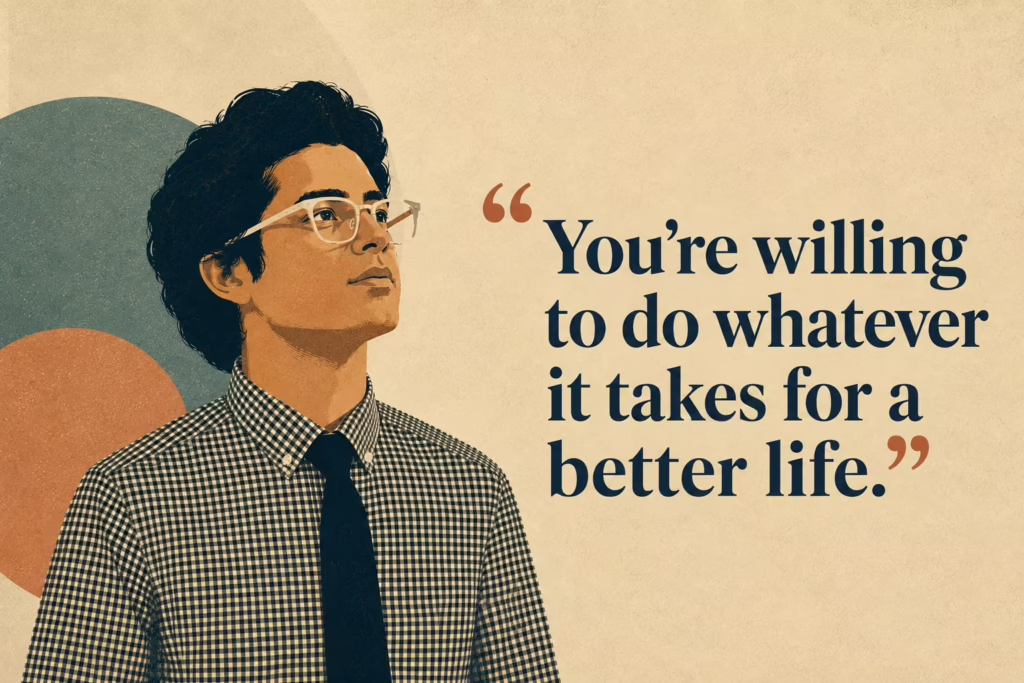
I landed in Toronto and then had to take a train from Toronto to Sarnia — a city in southwestern Ontario that borders the state of Michigan. I got on that train without even having a place to stay. It left at 6 and arrived in Sarnia around 11:30 p.m. My mom packed my pillow and a blanket and said, “Worst case scenario, you sleep on the floor in a park or wherever.” And I said, “Sure, I don’t mind.” As an immigrant, that’s kind of what you expect going in — you’re willing to do whatever it takes for a better life.
Taken In By Strangers
Before all that, I had tried to find a place to stay, but nothing worked out, and the college told me they couldn’t help. Then one of my teachers — she was from Mexico, so we both spoke Spanish — called me and said she might have a place for me, but she wasn’t sure because someone else was staying there for another week. She said she’d get back to me. That was near the start of the train ride.
About an hour and a half before I arrived, she called back and said the people staying there were actually moving out right then, so I’d be able to stay after all — I just needed to fill out some paperwork quickly on the train. It was strange: I arrived, and two strangers came up and asked, “Are you Sebastian?” I said, “Yes, I am.” They said, “We’re Spencer and Lana.” It was surreal — I was in another country, speaking English, which isn’t even my favourite language, thinking, “My life is about to change a lot.” I had no idea at the time that they were Christians.
I ended up living with them for almost three years. At the beginning, they were always busy, coming and going — mostly for church meetings — and I didn’t think much of it. I figured they were just doing their own thing.
Resistant to the Gospel
Sleeping Through the First Meeting
One time, Lana — the wife — asked if I’d like to come to a meeting. I said sure, why not; I wanted to get to know people, improve my English, and have some kind of social life. I remember going for the first time — I’d arrived on a Sunday, and this was the following Sunday. I was so exhausted that whole first week from speaking English 24/7 that I was sleeping ten-plus hours a night.
So at that first meeting, I basically slept through the whole thing. I listened for the first five minutes, then only really woke up when someone raised their voice or slammed the pulpit. I remember thinking, “Why is this guy so worked up — so devoted to this?” I thought it was crazy. Honestly, I thought these people were a little crazy, almost like it was a cult. It just didn’t feel normal to me at the time.
“This Is Stupid” — Sin and Hell
For that first month, I’d listen to the message and think, “This is stupid — why would they be so devoted to something that doesn’t even exist, or that’s fake? What’s the point?” They’d always talk about sin, and about needing to believe in Jesus so He could save you from hell. At the same time, I knew I was a sinner, because that’s what they kept focusing on — explaining what sin is, that we’re headed to hell, and that we need Jesus.
But where I’m from, in a lot of South American countries, we know we’re sinners — we just joke about it. We’ll say, “oh yeah, we’re going to hell,” and laugh it off. We don’t actually care. I was pretty much the same way: “I’m just here to work, live my life, and go to bed” — that’s just life, you know.
Related Reading
If any of that sounds familiar — knowing something’s wrong but not seeing why it matters — this is worth a read:
Eight Months of Questions
I kept going to those meetings — there was a Sunday meeting and a gospel meeting — for about eight months. Over that time, compared to how I felt at the start, I went from not believing at all and thinking it was stupid, to actually starting to believe some parts of it might be true. I did my own research on Google, read some books, and I’d bring hot-topic questions to the Christians around me.
One thing I really admired about them was that they always answered with Bible verses — they never just made something up. They’d say, “go read this chapter,” or “read this verse.” Pretty much all my questions got answered well, and that impressed me. It was something I genuinely started to admire about them.
Turning Points
The Bible Conference and “The Same Message”
After those eight months, the city of Sarnia had its annual Bible conference — where they give a message on a particular part of the Bible and how to apply it to Christian life. It’s just something they do. This was May 2022, and I went. I lasted about half the morning before falling asleep through the rest of it. I remember thinking, “this is boring again,” and getting annoyed — like, why is it always the same message, what’s the point?
I said as much to Spencer afterward. He asked what I thought of the message, and I told him, “honestly, everything was the same — it’s so boring.” He said, “well, that’s the point. It’s about Jesus — that He died, was crucified, rose from the dead, and paid for your sins.” I remember thinking, “okay, that’s kind of a lame answer, but sure, okay.”
Breaking of Bread: Something Different
But something happened right after that conference. For the first time, I was able to attend a Sunday morning meeting — what they call the breaking of bread, or the Lord’s Supper. It was completely different from the gospel meetings. A lot of the gospel meetings had felt convicting in a way that could come across as, “you have to do this, you have to do that,” and I’d think, “what if I just don’t want to?”
But at that first breaking-of-bread meeting, I heard Christians talk in a way that felt much more personal — like I was hearing genuine love for Christ, not just obligation. After that, I asked if I could start coming to the morning meetings with them, and they said, “sure, why not.” So I started going.
Sunday School and a Bible Memory Challenge
I also started attending Sunday school — I ended up in a class with kids, about ten-year-olds, because I was friends with the teacher and he invited me to come along. They have a kids’ message at the same time as the adult service, and honestly, it was hard to follow. They were talking about “the feasts” — a pretty complicated topic in the Bible — and I found it perplexing.
We were reading through John chapter 3. By the time I joined, the kids were already memorizing it — the teacher had asked them to memorize the whole chapter, about thirty verses, by the following week, and offered twenty dollars to anyone who did it. He never said I had to do it too, but my pride kicked in: I wasn’t going to be shown up by a bunch of kids. At that point, two people from the church had already given me two Bibles, so this was actually the first time I opened one. I read the whole chapter during work breaks and ended up memorizing it pretty easily.
Related Reading
If you want to go deeper on that chapter yourself, this is a good companion read:
Reading John — And Finding Grace
Reading Through John
From there I just kept reading — all the way to chapter 19. By this point, I’d already been to a lot of meetings, and I pretty much knew the verses posted around the building; you get used to them the way your ear gets used to a sound. One verse that stuck with me especially was Ephesians 2:8–9. I’d open my Bible to it — page 1796, I still remember — and read: “For by grace you have been saved through faith, and that not of yourselves; it is the gift of God, not of works, lest anyone should boast.” That verse stayed with me through those eight months.
The Tension Between Grace and Works
That verse stuck with me because, now that I was starting to believe some of this might be true, I wanted to somehow give something to God — I thought maybe I could do something to make Him love me more, or to be accepted. Part of that came from growing up Catholic, where I remembered being taught that you have to do good actions because God balances your good actions against your bad ones when you get to heaven. So when I started believing, that was still sitting in the back of my mind, and I kept thinking, “I have to do something.”
Around that time, people kept bringing up that same verse, and honestly it annoyed me — I’d think, “okay, then what am I actually supposed to do?” I was still confused about it.
“It Is Finished”
Around this same time, I was reading through the book of John and came to chapter 19, verse 30. For context — John is basically a biography of Jesus, covering a lot of His life, and by this point in the chapter, Jesus has already been crucified. The verse says:
“So when Jesus had received the sour wine, He said, ‘It is finished!’ And bowing His head, He gave up His spirit.”
At that point in the story, Jesus had already been put on trial, mocked, and not recognized as the Messiah — and He was crucified, which was simply how penalties were carried out back then.
I was reading that chapter on a Sunday afternoon, going over it again and again, and along with the other verse that had already stuck in my mind, something clicked. I came to realize that the work was done — that Jesus’s death on the cross was enough, by itself, for me to be saved. I was able to take that into my heart, and that was the first time I really thought: it is finished, and He died for me.
Taking Christ as Saviour
At the time, it felt like — I don’t know how to describe it in English — a sensation of warmth, but also satisfaction. I remember thinking, “this is it, I’m done,” because it had been stuck on my mind so much that I just knew: I need to do this, I need to get saved. And that was the moment I took Him as my Saviour.
It was the best decision I’ve ever made — but I honestly wasn’t expecting to have Jesus in my life at all. I think about this a lot: if I could go back in time and talk to myself before I was a believer, I can picture myself bullying that version of me for becoming a Christian, for believing any of this. I used to mock people who believed this stuff and make fun of it. But it’s by far the best decision I’ve ever made, and it’s the decision I’ll be living out for eternity.
A Free Gift, Still Open to You
Tonight, the believers here are going to pray that you get to know Him the way I did — because Jesus is a Saviour for the whole world. I remember one of my own feelings at the very beginning: I felt like a stranger walking into a building full of strangers, thinking, “this message isn’t for me, it’s for them — I don’t believe this, so why should I even consider it?”
But this message really is for everyone. If you feel a little awkward, or like this isn’t for you, you’re welcome to come talk to me or Vince after the meeting — we’d be glad to have a chat. This is something you have to deal with, because it’s important to come to know Jesus as your own personal Saviour.
Tonight after this meeting, and in the days that follow, we’ll be praying here for non-believers — for their safety, and because it’s important to get to know Jesus. We only have a short time here on earth, compared to eternity.
You need to understand that the job is finished — there’s nothing else left for us to do. You can’t work your way to heaven. Ephesians 2:8–9 says it’s a free gift. And when you receive a gift, it’s usually free — nobody says, “happy birthday,” and then, “by the way, you owe me twenty bucks.” That’s not how gifts work. It’s a free gift from God, and you simply have to accept it. If you don’t accept it, you’re not taking the gift — you’re not accepting that Jesus died for you.
So if you remember one thing from my whole testimony, let it be this: the job is done. It is finished. And there’s a free gift from God waiting for you to accept.