
Jesus receives sinners, though religious leaders criticize Him
Here in this passage, the Lord Jesus is one who receives sinners. In fact, again, I know we touched on this last evening, but those Pharisees came. Those Pharisees came, and the scribes, they came as they watched the Lord Jesus. They sought to criticize Him, and they murmured against Him. And while they murmured against Him, they sought to discredit the Lord Jesus. They said, “This man receiveth sinners and eateth with them.” What kind of a man is He?
Do you know, while they sought to criticize the Lord Jesus, they made known the love in His heart, because this man receiveth sinners and eateth with them. In fact, sinners are the only people the Lord Jesus receives.
You know what the Lord Jesus said on one occasion? “I came not to call the righteous, but sinners to repentance.” And it is people who identify themselves as being sinners, accepting what God says about them, that they are ungodly sinners. It is those people whom the Lord Jesus calls. It is those people whom the Lord Jesus receives the love of His heart. This man receiveth sinners and eateth with them.
Those men came to criticize the Lord Jesus. But there was another group of people. They were the sinners, and they gathered to hear the Lord Jesus. And while these people came to hear the Lord Jesus, the Lord Jesus then began to speak a parable.
Parables reveal truth to those willing to hear
Now, often times in the Word of God, in the life, the experience of the Lord Jesus, He spoke in parables. There are at least three reasons why the Lord Jesus spoke in parables. Number one, it was a fulfillment of Scripture, because Isaiah said that He would come speaking in parables. So it was a fulfillment of Scripture.
It was also, we read in Matthew chapter 13 as well, that the Lord Jesus spoke in parables to conceal things from those who didn’t want to hear it. People who had hardened hearts and didn’t want to hear the message of the Lord Jesus, the Lord Jesus spoke in parables to conceal truth from them. But there was another reason why the Lord Jesus spoke in parables: to reveal truth to those who wanted it. To reveal truth to those who wanted it.
Now, as we stand here tonight in front of you and as you sit and listen to the Word of God, do you want to hear His voice? Are you desiring to hear from Him tonight? Because if you want to hear from Him, He’ll give you light. Because that’s what God does. God is the revealer of light. He revealed light in the darkness in Genesis chapter 1. When the whole world was enwrapped, engulfed in darkness, He shone light into the darkness. And the same God who shone light into the darkness at creation’s morn is the same God who is shining light into the darkened circumstances of sinners in a meeting like this tonight.
In a world in which we live, in our condition as sinners lost before God, God is seeking to shine light. And the Lord Jesus, in a most masterful way as only Christ could do it, began to speak this parable about a shepherd.
The lost sheep is in danger and cannot return alone
A shepherd who had a sheep. He had a hundred sheep. And these 100 sheep, they were all gathered in the wilderness. And while those sheep were gathered in the wilderness, there was one sheep that went astray. And that shepherd, out of love and out of compassion, he went and he sought that sheep that was lost. Were we not singing last night? “In tenderness, He sought me, weary and sick with sin. And on His shoulders brought me back to the fold again.” Thank God for a shepherd who is seeking lost sheep. Thank God for the tender heart of Christ moving out to reach sinners in their darkest need and in their deepest need.
It is interesting just to set the background and the stage of this chapter. The Lord Jesus tells one parable. We read about that in verse number three. He spoke this parable. But that parable comes in three different parts. There’s the parable about a lost sheep. There’s a parable about a lost piece of silver. And there’s a parable about a lost son. And those three different things, those three different items, those three objects, they all tell us a little bit of a different story about the condition of sinners.
You see, whenever it’s that son, he’s at a distance from the father. Every sinner tonight, not saved, lost in your sins, you’re at a distance from the Father. The lost silver, it was in the darkness of a home. And every sinner tonight who is not saved, lost before God, is in the darkness, in the darkness of their sins. But I think of that sheep. One of the things that is really seen in the story about the sheep is the danger that it is in—the danger that it is in. When that sheep wandered off, it was now in a position of grave danger.
But I tell you tonight, if you’re not saved, you’re at a distance from God. If you’re not saved, you’re in the dark. If you’re not saved, you’re in danger. And that’s why we come to you tonight, friend, with a message from God. Because in the danger in which you are in, God wants to save you. God wants to deliver you. You know what the Word of God says? There was a man who came to two gospel preachers on one occasion, and he said, “Sirs, what must I do to be saved?” He realized he was in danger and he needed to be rescued. He needed to be delivered. He needed to be saved. He said, “Sirs, what must I do to be saved?” What was the answer? “Believe on the Lord Jesus Christ, and thou shalt be saved.” Those who believe on the Lord Jesus are those who are delivered from the danger in which they are in.
So the first thing I want you to consider briefly with me is the condition of the sheep. The condition of the sheep, because here was a sheep, and you’ve been hearing already that word location, and we’ve been thinking about our direction. And that’s what I want you to think about first of all: the direction of the sheep. The direction of the sheep. It was going away from the shepherd. Going away from the shepherd. I think of Brother John was telling me about Tom Armstrong. He is a man from Northern Ireland, and he used to have sheep. Whenever Rachel and I, my wife and I, were over in Northern Ireland, we were visiting Tom and his wife, Jenny. Tom began to tell me about the different sheep that are found in Northern Ireland. There’s the black-faced sheep, there’s the white-faced sheep, the blue-faced sheep, and the gray-faced sheep. There might be other kinds of sheep; I don’t know, but those are four of them that he told me about. And he said, “Tim, you know, there’s something interesting about those four different types of sheep.”
“They all go astray.” They all go astray. Every single one of them. Doesn’t matter what kind of sheep they are. It is in their nature to wander. You know what the Bible says about you and I? Isaiah 53 and verse number six says, “All we like sheep have gone astray. We have turned every one to his own way. The Lord hath laid on Him the iniquity of us all.” You are like a sheep. You are like the sheep, friend, in the story that we’ve read. And the direction is away from the shepherd.
If you’re not saved tonight, you get to look at this chart, this chart that depicts truth that is found in the Word of God. And the truth that is found in the Word of God is that if you’re not saved, you’re on that broad way and you’re going down to destruction. The direction is going away from God. Going away from God.
Has there ever been a moment in your life when you understood that you’re going away from God, that you are going astray? You’ve heard it already. You could have religion. You could have a knowledge of the Scriptures. You could even have the ability of preaching the gospel. In fact, there was a man by the name of John Wesley. Was it John Wesley or Charles Wesley? One of the Wesley men. They came across from Europe over to the United States of America. And while they were preaching the gospel, they saw souls converted to God, people that were born again. One of those Wesley men, as they saw these people who were converted to God, said to himself, “How can I preach a message when I don’t know the reality of life that these people are getting? I don’t have it myself.” He went back to Europe and he trusted Christ as his Savior. A moment when he understood he was going the wrong way. He had a great discovery. My friend, you could have it all: religion, prominence, all the things a life could give, all the knowledge of the Word of God, and you’d still be in your sins on the road to hell.
The direction of the sheep was going away from the shepherd. How do we know that’s our direction? Well, the Bible tells us, and I’ve already quoted that verse in Isaiah 53. But, you know, there’s something else. Not just because the Bible says it, but because our behavior manifests it. Seen in our behavior. That’s why we do the things we do. You say, “Tim, I’m a pretty good—I’m a pretty good living citizen. You don’t know the kind of life I live. I’m a pretty good girl. I’m a pretty good boy.”
What about the thoughts in your mind? Have you ever thought to yourself, “That lady down the street, she’s a bad girl, but I’m not that bad. That fella who I work with, he’s a bad guy. I’m not like him.” And sometimes we begin to compare ourselves with other people. And inside of our minds, you know what we think? We paint a pretty good picture of ourselves, and we get lifted up with pride. You know that pride is sin. That’s a sinful thought. It’s in the very mind.
Our actions, our words, our thoughts, they all manifest the reality of our sinful condition before God. Thus, the Word of God says without exception, all have sinned. The Bible says there is no difference. I know there are times when it seems like we are repetitive when we preach the gospel, but there are some people in this meeting, and maybe you just haven’t understood it before. There is no difference. There’s no difference, friend, between you sitting in your seat and a person who is in the penitentiary for murder. Because the Bible says there is no difference, for all have sinned and come short of the glory of God.
Repentance means agreeing with God about your sin
There’s no difference. The direction of the sheep—but not just the direction of the sheep. Really, there is the determination of the sheep, because once a sheep begins to go astray, it really has in its mind just a stubborn will to continue on that course. And sadly, there are people in this meeting tonight—you’ve determined, haven’t you, to continue on this course? Nothing’s going to stop you. The Word of God says that there is a way. “There is a way that seemeth right unto a man, but the end thereof are the ways of death.”
My friend, don’t harden your heart. You know what Proverbs says? Proverbs 29, I think it is: “He that being often reproved hardeneth his neck shall suddenly be destroyed, and that without remedy.” My friend, don’t remain in the stubbornness of your condition. Don’t remain determined to go your own way. It will end in disaster. There’s only one way that counts. There’s only one person that counts, and it’s Christ, the Lord Jesus. And that’s why we compel sinners to trust in Him, to turn to Him. Make Him your Savior. Make Him your all. Go in for Christ, and go in for Christ tonight.
There is as well the danger of the sheep. The great reality: that sheep that was in the wilderness, if that sheep did not get back to the shepherd—but there were dangers out there. Do you know what kind of dangers? Do you know what kind of dangers would have been in the wilderness for a sheep? There were lions there. There were bears. There were wolves. There were ravines and rivers and all the rest. This sheep needed the shepherd to survive. Without the shepherd, it would perish. My friend, without Christ, you’ll perish. Without Christ, not only a life that is marked with sin, but an eternity that is marked by sorrow and suffering.
There is a most solemn question in 1 Peter chapter 4. You know what it is? “What shall the end be of them that obey not the gospel of God?” That’s a solemn question. For those who remained in their sins, for those who never went in to find Christ, what shall the end be of them that obey not the gospel of God? You know what the Bible says? Revelation chapter number 20 and verses 11–15. John depicts this scene in space. It’s the final judgment of God. And the Lord Jesus is sitting on this great white throne judgment. It’s great because of His authority. A great throne. The throne white because of His purity. It’s great because of His majesty. He’s sitting on His throne.
You know the Bible says, “The dead, small and great, stood before Him, and the books were opened, and the people were judged according to the things that were written therein.” Sins that have been committed, maybe sins that have long been forgotten about, all recorded by God. And in that day, you’ll stand before Him with not a word in your own defense, and He’ll say, “Depart from me, ye cursed,” to face the everlasting burnings of a real eternity separated from God. It’s a danger. And sadly, there are people tonight, and they don’t realize the danger they’re in.
Up to this point, perhaps you’ve ignored the problem. Up to this point, you just didn’t want to face it. Up to this point, maybe you’ve been trying to run from it. My friend, don’t run from your problem. You face your problem tonight. You acknowledge your problem before God. Because those who acknowledge their sin before God are those who receive God’s salvation. Acknowledge to God, “I am a sinner.” That’s what repentance is: having an attitude that changes, an attitude that was once against God but now agreeing with God. That’s what it is to repent: to agree with God against yourself. If God says I’m a guilty sinner, then I am a guilty sinner. If God says I’m an ungodly sinner, I am an ungodly sinner. If God says I’m a lost sinner, I am a lost sinner.
That was the condition of the sheep, far away from the shepherd. But could I tell you tonight about the great compassion of the shepherd? There was a sheep in that condition, and yet here was a shepherd who was moved with mighty compassion, tenderness, and love. Think about it, friend. Such creatures as we who have rebelled against God. And yet the Bible says, “For God so loved the world that He gave His only begotten Son, that whosoever believeth in Him should not perish but have everlasting life.” And God sent His Son. And the shepherd, He willingly came. He willingly came. There was a desire in His heart. There was a distance that He was willing to go. He came right to where that sheep was.
Could I tell you, there was something that this shepherd never experienced that the Lord Jesus did. This shepherd came to where that sheep was, searching for that sheep. But the Lord Jesus, He died for the sheep. John chapter 10 and verse number 11, you know what it says? “I am the good shepherd. I am the good shepherd. The good shepherd giveth his life for the sheep.”
Christ gives His life to rescue lost sinners
I was walking downtown Ottawa the other day, just in front of city hall, and there was one of those memorials set up for the firefighters, likely in association with what happened in 9/11 and in honor of the firefighters in the Ottawa area. And just on the side of the memorial there’s that verse in John 15: “Greater love hath no man than this, than a man lay down his life for his friends.”
You know, I was reminded of a story. A man by the name of Billy McFaden. Billy McFaden was born in Luren, Northern Ireland. This story came to me today because Eric and I did the tour of the War Museum, and one of the murals in the War Museum was about the Battle of Son in France in 1916.
Well, Billy McFadson, he grew up in a fairly wealthy home, and he left his companions, left his business to go and serve in the war. He joined one of the battalions that was linked to the Brits, those in Northern Ireland. I’m not quite sure what it was actually. Was it some kind of a battalion? Might have been the Irish battalion or whatever it was. Anyway, he joined this battalion, and off he went to the war. Billy McFadson, six foot, 20 years of age, and he went to the battle. July the 1st, 1916.
Billy McFadson was in there with his comrades in the trench. They were about to go over the top. Early in the morning, there was someone who was walking about, and there was a box full of grenades that toppled over in the trench, and people began to scatter. And Billy McFadson, 20 years of age, out of love for his companions, stretched himself over those grenades and bore the blast to save his comrades. He was given one of those medals as a result of that heroic act of sacrifice.
And at that ceremony, it was that verse that was quoted: “Greater love hath no man than this, than a man lay down his life for his friends.” Could I tell you tonight, friend, of heaven’s love that surpasses the love of any human being, heaven’s love that moved to save you from your sins?
Heaven saw your danger, eternal, and heaven saw that you could do nothing about it. Maybe there’s people tonight in this meeting, and you think you can do something about your sin. You think if you work a little bit harder, you’ll be able to deal with the problem of your sin. You think, if I attend church a little more, if I give a little more money to the poor, if I be a better citizen, I can do something about my sin. My friend, you can do absolutely nothing about your sin. You are without strength. Like that sheep that was far away, far away from the shepherd, it could do nothing to save itself. It needed a Savior. It needed a shepherd.
My friend, tonight, where you are in your sins, you need a Savior. You need Christ. And that’s why we preach unto you the Lord Jesus, preaching peace through Jesus Christ. He is Lord of all. And we preach Him to you tonight: the great search of the shepherd, the great sacrifice that He made, the salvation that He offers. Oh, my friend, listen to it tonight. While the Lord Jesus is in heaven, He is welcoming sinners to come unto Him. He says, “Come unto me, all ye that labor and are heavy laden, and I will give you rest.”
You see, friend, the Christ who died on Calvary’s cross, who entered into death, who tasted death for every man, who was buried in that tomb on the third day, God raised His Son from the dead. And tonight, the Lord Jesus is at God’s right hand, and He’s compelling sinners to come to trust in Him. He’s looking for you, friend. Are you a lost sheep tonight? Are you a lost sinner? Would you agree with what God says about you and acknowledge that you’re lost there?
One of my favorite verses is in Luke 19:10. You know what it says? If you’re lost tonight, if you’re lost in your sin, you could find yourself in this verse. You know what the Lord Jesus said? “The Son of Man has come to seek and to save that which was lost.” When I was a boy, a seven, I drank in that truth. That’s why the Lord Jesus died. He came for me. I was the lost sinner that He came to save.
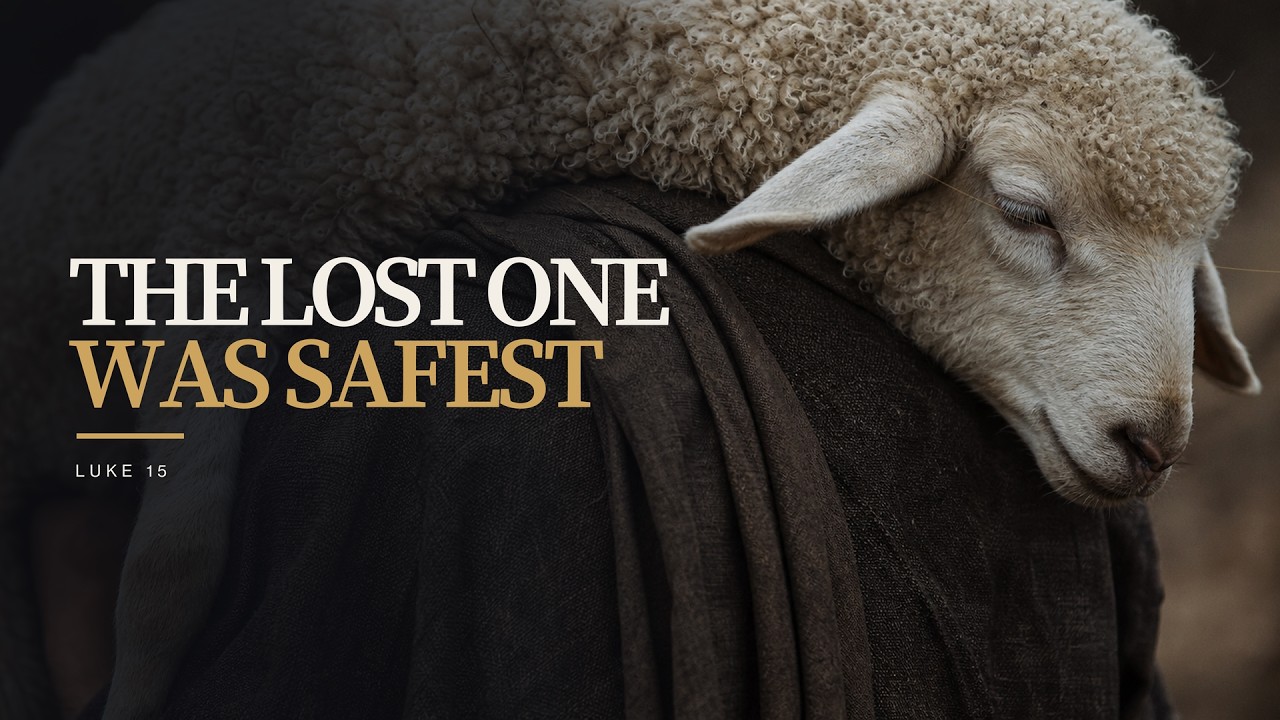
Here was a shepherd who went to find that lost sheep. I want you to think of the security of the shepherd. He found that sheep where it was, and he picked up that sheep, put it on his shoulders. Was there a safer place that sheep could be? Not at all. Place on the shoulders of that shepherd. You—I think of the words of the Lord Jesus. I was enjoying them earlier this week in John chapter 10. You know, He’s speaking of His sheep. He says, “I give unto them eternal life, and they shall never perish.”
It’s a wonderful thing to be saved. It is a wonderful thing to be saved. You know, there’s actually something greater than having God’s salvation. You know what it is for you Christians who are here tonight? There is something better than God’s salvation. It’s enjoying it. Enjoying it. Enjoying the salvation that you have from God. And here was a sheep who was once lost and now secured on the shoulders of the shepherd.
That sheep, I have no doubt—I don’t know if sheep have emotion or not—but if I was that sheep on that shepherd, I’d be enjoying the presence of the shepherd, the security. I enjoy the presence of the Lord Jesus every day. He is a wonderful Savior.
Heaven rejoices over one sinner who repents
You know, I think not just of the condition of the sheep and the compassion of the shepherd, but there is in this text the cheer of heaven, the cheer of heaven. Likewise, the Lord Jesus says—likewise—“I tell you, I say unto you, there is joy in heaven over one sinner that repenteth.” Over one sinner that repenteth.
Could I close with a contrast? The contrast that the Savior makes, because He says, “Likewise, I say unto you, there shall be joy in heaven over one sinner that repenteth, more than over ninety and nine just ones who need no repentance.” Tell me this: who was the safest ones in the story? The 99 in the wilderness or the sheep on the shepherd’s shoulders? Who was more safe? The 99 in the wilderness who didn’t need to be saved, who needed no repentance, or the sheep who was on the shepherd’s shoulders? It was the sheep on the shepherd’s shoulders.
There are a lot of people in this world today, and they think they’re all right. That’s one of the points the Lord Jesus is making here. Those ninety and nine were like the Pharisees. They didn’t think they needed repentance. They thought they were all right the way they were. But I tell you, they were in just as much danger as the sheep that was lost. But once that sheep was on the shoulders of the shepherd, that sheep on the shepherd’s shoulders was the safest sheep of all.
My friend, you come to Christ tonight. You find Him because He’s looking for you. And He wants to save you. He wants to save you from your sins. If you would trust Him tonight, if you would trust Him tonight, you could be brought into His sheepfold, and He could become your shepherd, and you could know what it is to be saved in time and saved for all eternity.