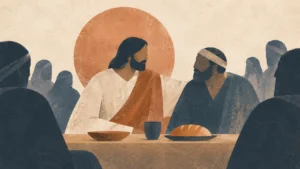
Trying to earn God’s favour through good works ignores what God has already done. Jesus Christ came into the world to save sinners, and nothing we do can replace His finished work.
Luke 18:13
12 mins
How Will You Approach God?
Two men approached God in very different ways: one trusting in his own righteousness, the other pleading for mercy. Only one went home justified.
Message Summary
Key Moments
Key moments from this message
The moments where Scripture opened and the gospel came clear — each with a short clip you can share.
-
01
Good Works Cannot Replace Christ
-
02
Come to Christ Just as You Are
God does not expect sinners to make themselves righteous before coming to Him. Christ invites us to come as we are and promises that the one who comes to Him will never be cast out.
-
03
Only One Man Went Home Justified
The Pharisee looked righteous but trusted in himself. The tax collector knew he was a sinner, cried for mercy, and went home justified.
-
04
You Cannot Save Yourself
A person who believes he can rescue himself will not take hold of the help being offered. Salvation begins when the sinner recognizes his helplessness and receives the rescue God provides.


Full Sermon Transcript
We’re going to read Luke 18, verse 10:
“Two men went up to the temple to pray, one a Pharisee and the other a tax collector. The Pharisee stood and prayed thus with himself: ‘God, I thank you that I am not like other men — extortioners, unjust, adulterers, or even as this tax collector. I fast twice a week; I give tithes of all that I possess.’ And the tax collector, standing afar off, would not so much as raise his eyes to heaven, but beat his breast, saying, ‘God, be merciful to me, a sinner.’”
Tonight I want you to try and answer one question: How will you approach God?
That’s really what this story is about. We have two men here, and we read at the beginning that both of them went up to the temple to pray — to the place where God dwelt, the place where people worshiped Him. Both men come and approach God, and each does it in his own way.
The Pharisee would have been a very religious man. He would have known all of the Jewish law and followed it as closely as he could. He would have made sure that everybody knew he was doing what was right according to God. He steps up almost to the temple, and here’s how he approaches God:
“God, Lord, I thank you that I am not like other men. I thank you that I’m not this terrible sinner. I’m not unjust. I don’t extort people. I don’t steal from people. I’m not an adulterer. And I’m not like this tax collector. Maybe I do the occasional little thing wrong — maybe I told a small lie to my parents, maybe I swore at that guy who cut me off on the freeway — but it’s no big deal. They’re small things in the grand scheme. I’m a good man. Thank you, Lord, that I am such a righteous man.”
I want you to understand that this is how the man presented himself to God: “Thank you that I am such a righteous man.” And even more than that — he brought some good works with him. Not only was he not like “those people,” and not only had he not done those things, but he actually gave to the poor. He gave some of his money to God. Surely that would take care of things. And not only that — he fasted twice a week. Surely that would take care of those little things he’d done. Overall, he was a pretty good man.
Here’s the reality: there are many people — including some of us, including probably most of us — who approach God exactly this way. We say, “I’m not that bad. I’m really a good person. I do all kinds of good things.” Now, I’m not discounting that it may be a good thing to give money to the poor. But when we read God’s Word, it’s very clear about us as mankind.
Romans chapter 3 says there is none that does good, not even one. No one understands. No one seeks after God. They’ve all turned away. None good, not even one. Isaiah chapter 64 describes it this way: our righteousness — our good deeds, our good works — is like filthy rags. It’s not that those things are necessarily bad in themselves. When I walked up here tonight, none of you could see the marks of sin underneath. It looked like I had on reasonably nice clothes — nothing you could see wrong with me. But the Bible is clear: man looks on the outward appearance, but God looks at the heart.
More than that — when the Pharisee, when you or I try to use our good deeds, our own effort, to make ourselves right with God, to gain favor with Him, to gain eternal life — it’s actually offensive to God. Why would that offend God, that we’re doing good things? Because we’re trying to replace something that has already been done. When we try to work our way into God’s good graces, we’re ignoring the fact that God has already taken care of our sin. He has already provided a way for it to be dealt with — through His Son, Jesus Christ.
First Timothy chapter 1, verse 15, Paul the apostle writes: “Christ Jesus came into the world to save sinners.”
Now think about the second man — the tax collector. When he came that day and approached God, he came with a full understanding of his sin. He showed up looking like exactly what he was. He knew his condition, and everyone else around knew it too. People would have looked at the Pharisee and thought, “There’s a good, righteous, upstanding man.” And they would have hated the tax collector, known as a cheat, a liar, and a thief. But that isn’t what mattered. It didn’t matter what other people thought of him. What mattered is that he showed up that day fully aware of his own condition.
The Pharisee stood there — I counted the words, about thirty of them, and they’re mostly about himself. The tax collector prayed seven words: “God, be merciful to me, a sinner.”
The story tells us — and I’ll read you the last verse now — “I tell you, this man went down to his house justified rather than the other.” To all appearances, everyone would have thought the first man was the righteous one, the good man on his way to heaven. But the Bible says it was the tax collector, the sinner, who went away justified. The Pharisee probably went home feeling no different than when he came. He probably still thought fairly well of himself — that he was a decent, upstanding man, and that what he was doing was enough to make him right with God.
Two men, two very different approaches to God — and they left in two very different conditions. Only one of them was justified.
We sang hymn 92 tonight, and those words over and over: “Just as I am, just as I am, I come.” God does not expect you and me to clean ourselves up. He doesn’t expect us to work our way into heaven or make ourselves righteous before we come to Him. He expects us to come just as we are. In John chapter 6, verse 37, the Lord Jesus says: “Him that comes to me I will in no wise cast out.”
How will you approach Him? We approach Him having recognized our sin, having repented of it, having understood the seriousness of our offense against God. The result is that we can be justified — made right in the eyes of God. Not on our own effort, not the way the Pharisee tried. When God looks at someone who is saved, what He sees is His Son, Jesus Christ — the perfect Son of God, who gave His own life on the cross so that you and I could be saved.
So tonight, our hope is that you will think about that question: How will you approach God? All God wants from you is for you to come. Come as you are. Recognize that you — that we — that I — am a sinner who needs a Saviour.
Maybe you’ve heard this example before: think of a person who is drowning. If that person believes they can get back to shore on their own, you could toss out all the life rings in the world, and they would never take hold — not until they recognize their need, and understand that they are absolutely helpless. Only then will they take hold of what is offered. Only then can they be saved.
We sometimes struggle to talk about sin. It’s not something people want to hear, not something we even enjoy talking about — but it’s the reality of our nature. When you realize your condition, you begin to understand the beauty of what Paul wrote: “Christ Jesus came into the world to save sinners.” The Lord Jesus said, “I did not come to call the righteous. I did not come to call the good, upstanding people. I came to call sinners to repentance. I came to offer them life.”
That’s our hope for you tonight — that you will simply come as you are and put your trust in the One who died on the cross. You could be saved.
Scripture quotations outside the historical sermon transcript use the New King James Version®. Copyright © 1982 by Thomas Nelson. Used by permission. All rights reserved. . The transcript preserves the wording used by the speaker.
Key scripture
“And the tax collector, standing afar off, would not so much as raise [his] eyes to heaven, but beat his breast, saying, ‘God, be merciful to me a sinner!’
Luke 18:13