
The question is not merely whether Jonah could survive in the belly of the great fish. The deeper issue is whether God has spoken truthfully.
21 mins
Jonah, Nineveh, and the Reality of Repentance
The book of Jonah presses a searching question: will we give God the credit for telling the truth? Through the repentance of the sailors and the people of Nineveh, this gospel preaching points to the need of repentance, faith, and identification with the sacrifice God has provided in Christ.
Summary
Key Moments
Key moments from this message
The moments where Scripture opened and the gospel came clear — each with a short clip you can share.
-
01
Is the Book of Jonah True?
-
02
Repentance Is Not Penance
Repentance is not paying a penalty for sin. It is a change before God: God is right, and I am wrong.
-
03
The Sacrifice God Has Provided
For the repentant sinner, God has provided a sacrifice: the willing, complete, and accepted sacrifice of the Lord Jesus Christ.
-
04
Believe God’s Word
Believing God means giving Him the credit for telling the truth. God has said it; the issue is whether we will believe Him.


Full transcript of sermon
The question I want to consider tonight, along with what we have read, is this: is the story, is the book of Jonah true? That’s what I want to consider. We’re going to come back to it later. Is the book of Jonah true?
The Lord Jesus, you might say, endorsed the book of Jonah in His teaching: “As Jonah was three days and three nights in the whale’s belly, so shall the Son of Man be three days and three nights in the heart of the earth.” He’s talking about what’s going to happen to Him. He’s talking about resurrection. He’s making reference back to Jonah.
But it’s interesting when you look at Jonah. We’ve read concerning these sailors and what they did: they repented. And we’ve read about the people in the city of Nineveh and what they did: they repented.
Now, repentance is something that is still preached, and so it should be. When the Apostle Paul summed up what he had been occupied with, speaking to the Christians and elders in Ephesus, he said, “I preached repentance toward God and faith in our Lord Jesus Christ.”
John the Baptist, you remember, was a forerunner to the Lord Jesus, making the way for the Lord Jesus to come. What did John preach? Repentance. “Repent ye, for the kingdom of heaven is at hand.” And remember how John was taken out of the way by Herod and put in prison, and the Lord Jesus came into the same area. And do you know what He preached? Repentance. “Repent, for the kingdom of heaven is at hand.”
We’d like to tell you a little bit tonight, my friend, about repentance: the reality of it and the need of it.
Repentance is not penance. Repentance is not taking a penalty for your sin. Some people, maybe they’re playing hockey, and they’re a few steps behind the guy with the puck and can’t seem to catch him. So they hook him with their stick, down he goes, the whistle goes, and they’re in the penalty box doing a penalty. Well, is the guy in the penalty box changed? No. He just got caught. His attitude isn’t changed. He can hardly wait to get back out there again. He’s just going to have to be more careful that the ref doesn’t see him.
Repentance is not taking a penalty for your sin. Repentance is not paying a fine to a church. Repentance involves a change. A change of attitude. A change that says God is right and I’m wrong. A change is involved in repentance. A change happens between God and the sinner.
These people that we’ve read about tonight repented.
First of all, the sailors. Remember the story of Jonah? God spoke to Jonah and told him what He wanted him to do. He wanted him to go to Nineveh, that great city, a city of the Assyrians. They were no friend of Jonah. They were no friend of Israel. And yet God was telling Jonah, “Go to Nineveh and preach the preaching that I tell thee.”
So Jonah goes down to the seacoast, finds a ship, and gets on it. It wasn’t going to Nineveh at all. He’s going in the opposite direction from where God told him to go. Away goes Jonah, but God has His eye upon Jonah.
What happens? A tremendous wind comes down. A storm comes along. Jonah has gone down into the sides of the ship, and he’s having a nap. He’s at peace, whereas these sailors are fearing for their lives. They’ve already thrown all the cargo overboard, and they’re trying to figure out how this has come upon them so quickly.
The captain of the ship goes down into the sides of the ship, and there is their passenger Jonah, having a snooze. The captain wakes him up and says, “Cry unto your God.”
Jonah comes up and talks to the sailors. The sailors say, “We’re going to cast lots. We’re going to find out who is responsible for this tremendous storm coming upon us.” They’re fearing that the ship is going to go to the bottom. So they cast lots, and of course, the lot falls upon Jonah.
Then they start asking the hard questions. “Where are you from? What’s your occupation? What have you done?”
Jonah tells them. He says, “I fear the Lord.” And he tells them about the Creator that is his Lord, the Creator who made the sea and the dry land. That’s critical. He’s telling these sailors concerning a God who is a Creator God.
Listen, my friend, there is lots of false teaching out there today, all kinds of it. But the truth is still the same: God is the Creator God, and without Him was not anything made that was made.
These sailors listen to that, and then they realize that if this storm has come from God, they start to pray. They were praying to their idols before. Now they are praying to the real God, the God they have heard about.
Then what are they doing? They’re trying to figure out what to do. Jonah says, “If you want the storm to cease, throw me over the side.” But he’s a paying customer, and so they row hard to bring the ship to land. What was the result of that? They got nowhere.
Finally, they pray to God again and say, “Don’t hold us responsible for this man’s blood.” Jonah is taken up. Jonah didn’t jump over the side. They threw him over the side.
This is so interesting. Do you know what happened? Jonah hits the water, and the storm stops. It stops dead, just like that. Becalmed.
There are times you read about in the Bible when the disciples were in bad storms. One time the Lord Jesus is walking on the water, and you remember He comes into the ship and the storm ceased. Another time He stands up in the ship and says, “Peace, be still,” and the storm ceased.
This is the opposite. The preacher is in the boat, and they throw him overboard. Once he hits the water, the storm stops.
This is a God that these mariners have come to realize is the true God. What do they do? The storm has stopped. These men feared the Lord. They offered sacrifices. What do they know about all of this? Isn’t it interesting? This is the Spirit of God dealing with these mariners.
My friend, we’d like to tell you tonight that for the repentant sinner, there is a sacrifice available. A sacrifice that happened when the Lord Jesus Christ was upon the cross of Calvary. In the darkness of Calvary, He offered Himself as one sacrifice for sin forever.
It was a willing sacrifice that the Lord Jesus offered. He was willing to do that. He knew exactly what was entailed. He was a knowledgeable sacrifice. He knew what the issues were. He knew what my sin was. He knew about your sin. He knew the question of sin that had to be dealt with.
This is the sacrifice of the Lord Jesus Christ. It was a complete sacrifice. In the Old Testament, there were thousands of sacrifices that were offered. But this Man, after He had offered one sacrifice for sin forever, sat down on the right hand of God.
It was a free sacrifice. He offered Himself freely. The sacrifice the Lord Jesus completed at Calvary cost God His only Son. But for us, if we will repent of our sin and turn to Him, here is a sacrifice.
But you know, the sacrifices of old sometimes were not accepted by God. Cain offered a sacrifice, and it wasn’t accepted by God. This is a sacrifice that God has accepted. It is a sacrifice that met all His claims: the sacrifice of His dear Son.
Often in the Old Testament, when a person brought an animal sacrifice, they put their hand upon the head of that sacrifice. They were identifying with that sacrifice.
Do you know what God wants? He wants individuals to identify with the sacrifice of His Son, that His sacrifice was for me. Identify with the sacrifice which God has provided.
These sailors offered a sacrifice. They made vows, a commitment. What a change. Here they were, a bunch of idol worshippers before this, and now they have come to understand about the true God. Repentance is what has happened.
The next thing that happens in our little story is Jonah goes over the side. The fish God has prepared swallows up Jonah. And in chapter 2, verse 1, you read, “Then Jonah prayed.”
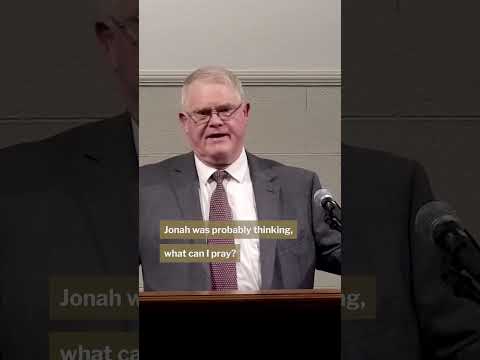
I like that. Then Jonah prayed. I take it Jonah hadn’t prayed when he left home. Sometimes when we’re going on a journey, we’ll say, “Lord, take us safely over the roads.” I don’t think Jonah prayed. And when he’s on board, the sailors are saying, “Pray.” The captain is saying, “Pray.” I don’t think Jonah prayed. Jonah is probably thinking, “What can I pray?”
But now he’s gone over the side, and the fish has swallowed Jonah. Then Jonah prayed. God is dealing with His man.
Jonah is in the belly of the whale three days and three nights, and he comes to this understanding: I will sacrifice unto the Lord. I will pay the vow. I will obey. Salvation is of the Lord.
God speaks to the fish, and Jonah is vomited up on dry land. The word of the Lord comes to Jonah again: “Arise, go to Nineveh, that great city, and preach unto it.”
Jonah didn’t love the city of Nineveh any more when he got out of the whale than he did before. He didn’t. But Jonah came to this conclusion: the first time there was a whale. I don’t know what’s going to happen the next time.
So Jonah heads off to Nineveh and starts to preach. He enters into the great city of Nineveh and starts to preach. His message was short: “Forty days and Nineveh shall be overthrown. Forty days and Nineveh shall be overthrown.”
And what happened? The people of Nineveh repented. That’s what we read about in Matthew, and that’s what we read about here. The people of Nineveh repented.
It’s interesting to see what they did. Firstly, they heard. You see, the sailors saw and they believed. These people of Nineveh heard and they repented. They believed. It says they believed God.
Remember, our question is: is the book of Jonah true? These people believed God.
If you were looking at some steps relative to repentance, they believed God. The sad thing is, many people never get past square one concerning believing God. If individuals are going to get a blessing, we need to believe God. That’s what these people did. They believed God.
They proclaimed a fast. You say, “What was that? They didn’t have supper?” No, it was much more than that. They were so focused upon the issue. Never mind having a big meal. Never mind the preparation, going for water, and going to the market. They were focusing upon the issue: the judgment of God is coming upon us. This is real. This is important. This is the priority.
They proclaimed a fast. They put on sackcloth. They weren’t worried about their outward appearance at all. It wasn’t, “Does this outfit make me look fat?” Nothing like that at all.
They were believing God. They were crying out to God. They put on sackcloth. They sat in ashes. They were crying mightily unto God. That was the occupation of that city. It had been a hive of activity, and now it has come to a stop. They’re crying mightily unto God. They’re turning from their evil ways and their violence.
Even the king himself and his nobles are agreeing with this. The message is going out as to what to do. And it’s interesting what the king says: “Who can tell if God will turn, if God will repent?”
What happened? God looked and He saw the people of Nineveh, and He saw the change.
There are a number of translations when it comes to verse 10 in chapter 3. The King James says, “God saw their works, that they turned from their evil way; and God repented of the evil.” I think there are better translations than that. The American Standard says God “relented of the calamity,” because there’s a verse that says, “Is God a man that He should repent?” Scofield gives help in this, that the root word for repentance when it comes to man is not the same as the word that is used here concerning God.
The Douay Bible, the Catholic Bible, says that God had mercy with regard to the evil which He said would come.
God is a spirit. The righteous character of God was such that the people of Nineveh, in their evil and wickedness, were coming up before God. So the character of a righteous God was to send judgment.
But now the people of Nineveh have changed. They have repented. And now there is another characteristic seen of a righteous God. It is God now showing mercy. Judgment withheld. A righteous God showing grace. Mercy and grace to people who didn’t deserve it. That’s what God is showing here relative to the people of Nineveh.
Jonah preaches the message. The people of Nineveh repent. God sees that, and the judgment doesn’t fall. In fact, not for another 150 years, after that generation and one following it had passed away, before judgment comes in upon the people of Nineveh.
But at this point, what are the people of Nineveh doing? They have believed God.
Do we need to repent? That’s the question. Do we need to repent? Do you need to repent?
Is there a place for repentance? God grants a place of repentance, the opportunity for people to repent. You’ll find that in the Word of God. There was a man called Esau, and he sought a place of repentance, and he sought it carefully with tears, for the time of repentance was passed.
God, a gracious God, a merciful God, is giving opportunity for souls to realize He is right, to believe God, repent, and turn to Him.
So our question was: is the book of Jonah 100% true? Is there a fish that can swallow a man, and the man be in the belly of the whale three days and three nights and still come out and go preach? Is that true?
There are people who look at the Bible and say, “Well, I have difficulty with Genesis and creation. Maybe if that wasn’t there. And I have trouble with Noah and the flood, that it was really just a local rainstorm. And I really have trouble with Jonah, the prophet being in the stomach of the whale.”
They’re considering all these things. But that’s not believing God.
Believing God is giving God the credit for telling the truth. That’s what it comes down to.
People so often come and listen to the gospel, and we like to see them come. The gospel is clearly preached, and we think, “How could they not take it in? How could they not understand? How could they not come and trust the Saviour?” And yet we don’t know concerning their thoughts: “Well, I like to pick and choose as to what’s true and what isn’t.”
God is looking for people to give Him the credit for telling the truth.
You can take all your ideas and all your research concerning whether a man can be swallowed by a whale shark, because that’s what some people say this was, or some other whale. You can take all your ideas and say, “I’m going to really research that. I’m going to consider that. I’m going to see if that’s right or not.”
And you can take that all and set it aside, and just change your thinking into this: God has said it. Is it true or not? That’s what it comes down to. God has said it. Is it true or not?
Because you can consider, and you can research, and you can question, and maybe make progress, and you can lose your soul because of it. That’s reality.
Give God the credit for telling the truth. The truth about who we are. The truth about creation. The truth about what He has done. The truth of this book, the Word of God. Say, “God says it. I believe it.”
You see, if we can’t understand the truth about these things, maybe we can just hopscotch over them and come to something about the Lord Jesus. Do you know what the Lord Jesus said to a man by the name of Nicodemus? “If I have told you of earthly things and ye believe not, how shall ye believe if I tell you about heavenly things?”
That’s what He said to Nicodemus. And that is absolutely true. That is absolutely relevant in the day in which we live.
My friend, the Word of God is true. And if you’re considering, if you’re contemplating, if you’re trying to figure this all out, know what it is: repent.
Scripture quotations outside the historical sermon transcript use the New King James Version®. Copyright © 1982 by Thomas Nelson. Used by permission. All rights reserved. . The transcript preserves the wording used by the speaker.
Key scripture
From that time Jesus began to preach and to say, “Repent, for the kingdom of heaven is at hand.”
Matthew 4:17
Related Messages


Questions about salvation?
If you’d like to learn more about what the Bible teaches on forgiveness or speak with someone from Ottawa Gospel Hall, we’d be glad to hear from you.