
Peace with God is not a human ideal waiting to be achieved. Jesus Christ made peace through His death and blood on the cross.
19 mins
The Peace John Lennon Imagined — and the Peace Jesus Made
John Lennon’s “Imagine” pictured a world at peace. John 14:27 points to a deeper peace—peace with God made possible through Jesus Christ and the cross.
Summary
Key Moments
Key moments from this message
The moments where Scripture opened and the gospel came clear — each with a short clip you can share.
-
01
Christ Did Not Imagine Peace—He Made It
-
02
The World’s Peace Cannot Satisfy
The world keeps offering peace that expires.
A better circumstance.
A solved problem.
A little more security.Christ offers something fundamentally different:
peace with God.
-
03
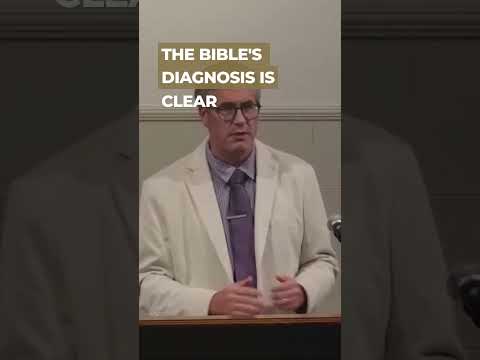
The Bible’s Diagnosis Is Clear
The Bible does not diagnose humanity's problem as bad circumstances or the wrong upbringing. It says that we are guilty sinners—and that peace with God comes through the Lord Jesus Christ.
The gospel begins with a clear diagnosis and points to a clear Saviour.


Full transcript of sermon
The Universal Search for Peace
If there is one thing we’re all looking for in life — not so much as young children, perhaps, but certainly as we grow into our adult years — it’s peace. It’s something all of us are searching for, one way or another. Perhaps it’s a longing you feel in your own heart tonight.
Open your Bible to John 14:27. Jesus, speaking to His followers, says: “Peace I leave with you, My peace I give to you; not as the world gives do I give to you. Let not your heart be troubled, neither let it be afraid.”
Tonight I want to speak about peace — humanity’s longing to have it, and what the Bible actually says about finding it.
The World’s Vision of Peace — And Where It Falls Short
About 55 years ago, John Lennon wrote the song “Imagine” — an anthem for human unity that remains widely loved to this day. Its opening lines still catch people off guard, imagining a world with no heaven and no hell. The song moves through a series of hopeful pictures: a world with no God, no right or wrong, no countries or borders, no sacrifice, no thought of tomorrow — just people living for today. If we could get there, Lennon suggests, humanity could exist in a permanent state of peace and unity, forever.
Editor’s Note
This message was preached in 2026. John Lennon’s “Imagine” was released in 1971, approximately 55 years earlier. The song was later formally co-credited to Yoko Ono.
It’s a song that speaks powerfully to our search for peace. But is it realistic? Is a world without religion, without conflict, without dying actually possible? Looking at human history, there has never been a time without war somewhere in the world — strife, fighting, and violence have always been present. In that sense, the song misses the mark. It assumes that if we removed God, removed the differences between rich and poor nations, removed the things that divide us, we’d naturally find peace.
But is that really the case? Are external things — conflict abroad, being a poor neighbour — really what’s blocking us from peace? Or is the problem something closer to home?
The False Peace We Settle For
We human beings are remarkably good at manufacturing our own sense of peace. Scripture and experience both point to at least three counterfeits.
Peace Through Comfort
Sometimes peace comes simply through the comfort of where we’re born or where we live. Jesus’ words in John 14:27 hint at this — “not as the world gives” implies that the world does offer some kind of peace. Living in Canada, we enjoy real comforts: a stable government, safety walking the streets, good jobs, financial stability, the freedom to travel and live as we please. That level of comfort brings with it a certain level of peace — but it’s a peace built on circumstances that can change.
Peace Through Control
There’s also a peace that comes through control. Maybe you’re a structured, orderly person — your finances are planned, your retirement is mapped out, you know what each day will bring. There’s no sickness in the family, your health is good, and you feel fully in control of your life (or so you think). That sense of control can offer a real feeling of peace, but it’s a fragile one — a foundation that shifts the moment life goes off script.
Peace Through Distraction
But there’s a third kind — maybe the one that speaks to you most tonight — and that’s the peace we get from distraction. You might know there’s conflict in the world, even in your own home, and turn to entertainment to escape it: scrolling on your phone, watching a movie, following sports — anything to distract from what’s really bothering you. And if you’ve grown up in a church like this one, having heard the gospel many times and set aside your need of a Saviour, you know deep down you’re on a road that leads away from God. So you distract yourself, changing the subject in your own mind, just to manufacture some facade of peace.
The Real Problem: A Heart at War with God
Whether it’s a song imagining away our differences, or the excuses we build through comfort, control, or escape — none of it actually solves anything, because it all depends on circumstances. None of it looks at where the real problem lies.
The problem isn’t ultimately with society, sinful as it is. There’s much in this world to fear, much to be wary of — but that’s not the root issue. The problem lies much closer than that: within every human heart. Our hearts are sinful. They stand in enmity against God, whether we realize it or not. If you don’t know Christ as your Saviour tonight, you may never have thought of it this way — but you are actually an enemy of God. You are not reconciled to Him; you are not at peace with Him.
And that’s not because of your upbringing, or where you were born, or where you live. It’s because of the sinful condition each one of us carries.
Psalm 28:3 puts it this way:
“Do not take me away with the wicked and with the workers of iniquity, who speak peace to their neighbors, but evil is in their hearts.”
We’re very good at looking and acting one way on the outside, while our hearts tell a different story. Our hearts are not at peace — they are at war with God.
Romans 3: “There Is None Righteous”
Turn to Romans 3, starting at verse 10:
“As it is written: ‘There is none righteous, no, not one; there is none who understands; there is none who seeks after God. They have all turned aside; they have together become unprofitable.’”
And verse 14:
“‘Their mouth is full of cursing and bitterness; their feet are swift to shed blood; destruction and misery are in their ways; and the way of peace they have not known. There is no fear of God before their eyes.’”
So not only are we at enmity with God, but the way of peace itself is something we don’t know — because we are far from Him. The Bible’s diagnosis is unmistakably clear. It doesn’t say you can blame your upbringing, or that you were simply born in the wrong place at the wrong time. It says plainly that we are all guilty, that we are all sinners — and that none of us have peace with God except through our Lord Jesus Christ.
So tonight, if you’ve never made a profession of faith — if you don’t know the Lord Jesus Christ as your Saviour — realize that you don’t have peace with God. You might act like you do. You might even say that you do. But without Christ as your Saviour, you don’t have peace with Him.
What Does John 14:27 Mean? How Jesus Gives True Peace
So how do we find true peace? How can we know peace with God?
Go back to John 14:27. Jesus was speaking to His followers — men who had already trusted Him, His disciples. He says again: “Peace I leave with you, My peace I give to you; not as the world gives do I give to you.”
Jesus is describing a peace unlike the world’s peace — the kind we’ve just talked about, which is circumstantial and temporary, something you can’t fully depend on because it changes constantly. But the peace Jesus was offering His disciples in that moment rises above the circumstances of life.
Consider the timing: as Jesus said these words, He was about to be crucified for the sin of the world. He was soon to be seized by the Jewish and Roman authorities, mocked, beaten, spat on, and hung on a cross to die for our sin. And yet He could say, “This peace I give to you.” That’s remarkable. Could you or I say something like that while facing death? Jesus could — because He is God Himself, God incarnate. “I can give you My peace,” He said.
So the peace that comes from God isn’t a peace dependent on circumstances. It doesn’t mean life will be free of problems. It’s far greater than that — it’s a peace dependent on the very person of God Himself.
He Made Peace Through the Cross
Turn to Colossians 1:19–20:
“For it pleased the Father that in Him all the fullness should dwell, and by Him to reconcile all things to Himself, by Him, whether things on earth or things in heaven, having made peace through the blood of His cross.”
When John Lennon wrote “Imagine,” the whole premise was hypothetical — imagine this, imagine that. His hypothesis was that if you removed enough of the bad things in life, removed God from the equation, you’d have peace. What does Jesus say? He made peace. That’s what’s so remarkable about the gospel. One song imagines peace, hopes for peace. Jesus made peace — through His death on the cross, through His blood.
Notice that phrase: “having made peace through the blood of His cross.” You or I could never say we made peace. We might try to broker peace between two parties, but sinful people don’t have the ability to actually make it. Jesus Christ made peace — and it came at a tremendous cost. This wasn’t a financial transaction; it was His own life, His own blood. It cost Him His life, and it required someone perfect — not just anyone nailed to a cross, but God’s own Son. That’s the significant event that made it possible for us to be reconciled to God, to enjoy fellowship and peace with Him.
Peace With God by Faith Alone
Tonight, you might be imagining peace and hoping for it in different ways — thinking that if life would just go a certain way, you’d finally have peace. And that’s true, to a point — you might have peace for a while. But like the peace deals we hear about in the news, that peace never lasts; the fighting starts again. Earthly peace is always temporary.
The peace of God, though, offers something eternal. Romans 5:1 says:
“Therefore, having been justified by faith, we have peace with God through our Lord Jesus Christ.”
For every believer, that peace comes through our Lord Jesus Christ alone — not through any effort of our own, and not through attending church. It’s through Christ, and Christ alone.
What Peace With God Actually Looks Like
In these last few minutes, I want to look at what this peace actually looks like lived out. Does it mean all our troubles disappear? Is life totally different? In one sense, yes — life is completely different, because we become a new creation. The Bible tells us we’re made new, and the Spirit of God comes to dwell within us. We’ll still face trials, but our whole focus in life changes.
Turn to Acts chapter 2. It’s not the passage we’d normally read at a gospel meeting, but I think it fits here.
Before I read it, recall the closing picture in “Imagine” — a world with no possessions, no greed, no hunger, everyone sharing everything, living together as one. It’s a beautiful picture, but it remains entirely in Lennon’s imagination — what peace could look like.
The Bible, by contrast, gives us a real, practical, real-world example of what the peace of God actually looks like. Look at Acts 2, starting around verse 41. These are just ordinary people who had been saved through the gospel Peter preached — convicted of their sin, repentant, believing. Look at their response:
“Then those who gladly received his word were baptized; and that day about three thousand souls were added to them. And they continued steadfastly in the apostles’ doctrine and fellowship, in the breaking of bread, and in prayers. Then fear came upon every soul, and many wonders and signs were done through the apostles. Now all who believed were together, and had all things in common, and sold their possessions and goods, and divided them among all, as anyone had need. So continuing daily with one accord in the temple, and breaking bread from house to house, they ate their food with gladness and simplicity of heart, praising God and having favor with all the people. And the Lord added to the church daily those who were being saved.”
It’s striking — that passage almost echoes the closing picture of “Imagine,” but from a completely different point of view, and yet arriving at a similar truth: when you have peace with God, it changes you from the inside out. Old interests fall away. You have a new direction, a new master — the Lord Jesus. Like these early believers, your desire becomes to be together with other believers, to serve the Lord above everything else.
This isn’t about literally selling everything you own — that’s not the point being made. The point is that these believers were so devoted to the Lord Jesus that they wanted to do everything for Him. They gave what they had to help others in need because they weren’t worried about their possessions; they were concerned for their brothers and sisters. That’s what being part of the family of God is about — a relationship with brothers and sisters in Christ that surpasses any earthly relationship, because it’s rooted in what Christ has done for us.
A Closing Invitation
Tonight, I hope you’ll think seriously about what we’ve talked about — and go further than just thinking about it. Recognize where you are. Recognize that the peace you’ve been looking for hasn’t really worked, and maybe it has, for a while — but ultimately, the peace this world offers will never fully satisfy you. Only the peace God gives through His Son, Jesus Christ, can truly and ultimately satisfy.
And there’s no need to simply hope for peace someday, waiting until we die to find out. You can know the peace of God for a fact, right now, in the very seat you’re sitting in — by placing your faith and trust in His Son, Jesus Christ.
Historical & Contextual References
- John Lennon — “Imagine.” The official John Lennon website identifies “Imagine” as a song written by John Lennon and Yoko Ono and released in 1971. The site describes it as John and Yoko’s “anthem for peace.” https://www.johnlennon.com/music/singles/imagine/
- Our World in Data — “War and Peace.” An overview of historical and contemporary armed conflict, including data on the prevalence of wars and how conflict has changed over time. https://ourworldindata.org/war-and-peace
Scripture taken from the New King James Version®. Copyright © 1982 by Thomas Nelson. Used by permission. All rights reserved.
Key scripture
“Peace I leave with you, My peace I give to you; not as the world gives do I give to you. Let not your heart be troubled, neither let it be afraid.”
John 14:27
Related Messages


Questions about salvation?
If you’d like to learn more about what the Bible teaches on forgiveness or speak with someone from Ottawa Gospel Hall, we’d be glad to hear from you.