Christ died for the ungodly and took the sinner’s place. Because he paid the price of sin, salvation is not earned by paying God back but received through repentance and faith in Christ.
#repentance #repentandbelievethegospel

25 mins
Jesus called Himself a doctor for sinners, not the self-righteous. A study of Luke 5:27-32 on repentance, grace, and what it means to truly need a Saviour

Jesus ate with tax collectors and sinners because He came for people who recognized their spiritual need. In Luke 5:27–32, Jesus compares Himself to a physician: the sick need a doctor, and sinners need a Saviour. His welcome of Levi and others exposes the danger of self-righteousness and shows what biblical repentance means. Christ took the sinner’s place at the cross, rose again, and now offers forgiveness and eternal life to those who repent and trust in Him.
Key Moments
The moments where Scripture opened and the gospel came clear — each with a short clip you can share.
01
Christ died for the ungodly and took the sinner’s place. Because he paid the price of sin, salvation is not earned by paying God back but received through repentance and faith in Christ.
#repentance #repentandbelievethegospel
02
Repentance is not an attempt to earn God’s favour or counterbalance past sins through good deeds and self-denial. Biblical repentance acknowledges our true condition before God: he is holy, we have gone astray, and we are guilty.
Repentance turns to God and confesses the truth about our sin.
Sermon
It’s on my heart tonight to begin with a question: Do you need a doctor?
Perhaps in Ottawa, or elsewhere in the province, or even across the country, many people don’t have a doctor — there’s a real shortage of family doctors. But that’s not really the question here. The question isn’t, do you have a doctor? It’s, do you need a doctor?
Maybe you need a doctor to renew a prescription that’s expired. Maybe you need a doctor for an annual checkup, to see how your blood pressure and heart rate are doing. But when do you really need a doctor? You really need a doctor when you’re not well — when you’re sick. Something’s wrong, and you know you’d better go see your doctor.
The Lord Jesus described Himself as a doctor — not in a physical sense, but in a spiritual sense: a doctor for our spiritual well-being, for our soul. Let’s look at a passage where He speaks about this. Turn with me to Luke chapter 5, reading at verse 27.
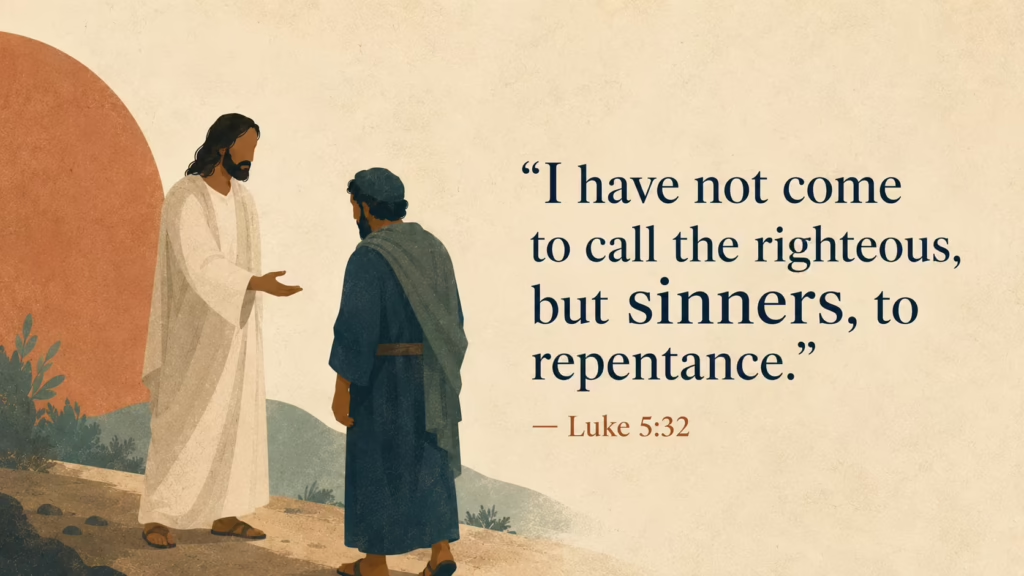
After these things, He went out and saw a tax collector named Levi, sitting at the tax office. And He said to him, “Follow Me.” So he left all, rose up, and followed Him. Then Levi gave Him a great feast in his own house. And there were a great number of tax collectors and others who sat down with them. And their scribes and the Pharisees complained against His disciples, saying, “Why do You eat and drink with tax collectors and sinners?” Jesus answered and said to them, “Those who are well have no need of a physician, but those who are sick. I have not come to call the righteous, but sinners, to repentance.”
I’d really like to underline that last part. The Lord Jesus answered: “Those who are well have no need of a physician or a doctor, but those who are sick. I came not to call the righteous, but sinners to repentance.”
I’d like to paint the scene for you. Here we have Levi, a tax collector. Every country collects taxes, and this was no different — there was tax collection. But there was one key difference: this tax was being collected for Rome, the oppressor nation ruling over Israel. Do you think people liked paying tax to Rome, the oppressor? No, they didn’t. They despised Rome and didn’t want Rome ruling over them. And did people like paying the tax collector himself? No — they despised the tax collector too, the one requiring them to pay.
On top of that, these tax collectors weren’t Roman. They were from their own nation — fellow Jews. So people felt betrayed: why are you working for Rome? They looked down on the tax collectors as traitors. And some tax collectors — perhaps not all — would collect extra tax they had no right to and pocket the difference. We don’t know if Levi was one of those, but tax collectors were known for it. So they were deeply despised.
That’s the situation: Levi sitting at the tax office, and the Lord Jesus comes along, sees him, and calls him: “Follow Me.” That’s really our plea for you tonight too — that you would follow the Lord Jesus Christ as your Saviour, just like Levi did.
Levi follows Him. And Levi has a large house, so he hosts a great feast, inviting his friends, co-workers, other tax collectors, and acquaintances — tax collectors and others. We don’t know exactly who “the others” were — maybe spouses, friends, or family. And Jesus is there, and the disciples are there. So are the scribes and Pharisees — though they aren’t participating in the feast. Perhaps this was a Mediterranean-style house with an outdoor courtyard; we don’t know for sure. But the scribes and Pharisees can see what’s happening, and they’re commenting on it from the sidelines without joining in.
Who were these scribes and Pharisees? A scribe was someone who diligently copied the Scriptures, meticulously precise down to the smallest stroke of a letter. They knew the Old Testament law extremely well. The Pharisees were very religious people who studied the Old Testament law and worked hard to fulfill it in their own lives. They had also added their own traditions on top of it and were careful to follow those too. So these were very religious, and — as we’ll see — self-righteous people. Here are these two groups, scribes and Pharisees, looking on.
So here’s the scene: Levi hosting a great feast, other tax collectors and people there, Jesus and His disciples there — and the scribes and Pharisees off to the side, looking on with disdain, asking, “Why are you eating with tax collectors and sinners?”
These scribes and Pharisees found fault with three groups of people: the tax collectors, “the sinners,” and the Lord Jesus and His disciples.
The Pharisees were trying to live by the book, trying to obey God’s Word — and here was a tax collector, working for the oppressor, Rome, not obeying God at all. So they found fault with him.
Notice the text says it was tax collectors and others sitting at the feast — but when the Pharisees looked at “the others,” all they saw were “sinners.” With judgmental eyes they looked down on them, placing themselves above: “We’re the Pharisees, we follow the law, we’re religious — but these people down here, they’re sinners.” It really says more about the Pharisees than about the people they were judging.
But really, they found fault most with the Lord Jesus. They had been watching Him, hearing His teaching, seeing His miracles, looking for a way to catch Him in His words — and here it was: if He was a religious man trying to keep Himself pure, why would He stoop to eat with tax collectors and sinners? In their eyes, He wasn’t living by the law, wasn’t keeping Himself pure — He was stooping to that level. They were, quite plainly, self-righteous.
The Lord’s response is priceless. Anytime you see a Pharisee ask Jesus a question in the Gospels, it’s worth noting His answer — it’s often profoundly wise. Think of when they asked whether it was right to pay tribute to Caesar. Whichever way He answered seemed to trap Him, yet He gave a perfect answer (you can look that one up, though it’s off our topic tonight).
Here they’re asking, “Why are you eating with tax collectors and sinners?” And notice Jesus’s answer: “Those who are well have no need of a physician.” What a profound answer. In one line, He answers why He’s eating with them, who He’s there to help, and who He isn’t.
He compares Himself to a doctor — not a physical one, though earlier in this same chapter He did heal a man with leprosy and a paralyzed man. But He didn’t come to earth primarily to be a medical doctor. He came to be a spiritual doctor, for our souls, for our moral condition.
“Those who are well have no need of a physician, but those who are sick.” Which category would you put yourself in — well, or sick? Are you right with God, or are you not right with God? It’s those who aren’t right with God who need a physician, and He’s about to point that out.
I was thinking of the news, how we hear about contagious illnesses like Ebola — and yet there are patients lying sick in bed, and who goes to them? Nurses and doctors, gowned up, willing to go to that bedside because they care. The Lord Jesus was willing to stoop in the same way — to come into this world and come down to the level of tax collectors and sinners, because they needed help. And if we’re honest with ourselves, we need to identify with those sinners too.
What is a sinner? What is sin? Sin is anything that goes against God. We could read the Ten Commandments and the other commands of Scripture — not to lust, covet, be greedy, lie, murder, commit adultery, harbor bitterness, pride, envy, or jealousy. Does anyone here have any of that? If we’re honest, we’d all have to admit: I have sinned before God, against His holy standard. I have come short. In fact, the Bible tells us that we have all sinned and come short of the glory of God (Romans 3:23).
So what’s this doctor’s remedy? He’s come and sat down with the tax collectors and sinners — He’s there for them. His remedy: “I have not come to call the righteous, but sinners, to repentance.” He is calling these people to repent.
What is repentance? Repentance isn’t doing some great deed to earn God’s favor. It isn’t giving money — there’s nothing wrong with giving to charity or doing good to your neighbor, but that isn’t repentance either. And repentance isn’t penance. The words sound similar, but they’re not the same thing. Penance is the invented idea of denying yourself something to counterbalance the wrongs you’ve done — you won’t find that in the Bible; it isn’t a biblical teaching.
Repentance is acknowledging before God my real state: I have sinned. I am the sinner, and God is holy. I have gone astray. I am guilty. Repentance is turning to God and confessing to Him.
This verse tells us He’s calling sinners and tax collectors to repentance — but He says He has not come to call “the righteous.” It was the Pharisees who considered themselves righteous, at least in their own eyes, and His answer really highlights their condition. They thought they were whole, that they were right with God, because they were trying hard to obey the Old Testament law and the traditions of their fathers, trying to earn a place in heaven. And so they didn’t think they needed a doctor. They thought they were fine.
Is that you? Maybe you’d say, I’m a good citizen of Canada — I’ve never murdered anyone, never robbed a bank, I file my taxes honestly, I don’t steal. I don’t have a criminal record. That’s a good standard — but it’s not heaven’s standard. That’s Canada’s standard. Heaven’s standard is far higher. Which of us can claim to be morally pure, never guilty of pride, jealousy, bitterness, lust, envy, anger, or greed? If we’re honest, we have to admit: I’ve sinned before God. I’m not righteous. The Lord Jesus is really calling these self-righteous Pharisees to recognize that they are sinners themselves.
The Lord Jesus makes this same distinction again and again — between the self-righteous and those despised in society.
Think of the story we call the prodigal son: two sons of a farmer. The younger son goes off to a far country, wastes everything on sinful living — but down there, he comes to his senses, recognizes “I have sinned,” and repents and comes home. His father receives him joyfully. That’s a real picture of repentance: recognizing “I have gone astray, I have done wrong,” and coming back.
The other son was obedient — worked in the field, didn’t complain, wasn’t like his brother. And yet he wasn’t blameless either. He had bitterness in his heart, envy toward his brother, resentment — and in the end he disobeyed his father and refused to go in to the feast. His sin wasn’t as outward as his brother’s, but it was still there. Someone blatantly not living a righteous life on one hand; someone who appears righteous outwardly but still has a sinful heart on the inside, on the other. And the Lord makes the distinction: it was the repentant son who was received into the feast, while the self-righteous son stayed outside, refusing to go in.
Here’s another example of the Lord distinguishing between the Pharisee and those despised in society. A Pharisee named Simon was hosting Jesus at his house. In those days, people walked dusty roads in sandals, and it was customary for a host to have a basin of water ready to wash a guest’s feet. But Simon didn’t wash Jesus’s feet — didn’t even have anyone else do it. Instead, a woman comes to Jesus’s feet, a woman known in the town as a sinner. Simon thinks to himself, if this man were really a prophet, He’d know what kind of woman this is.
Yet Jesus calls Simon out directly: “Simon, I have something to say to you. This is your house — it was your duty to have My feet washed, but you didn’t. This woman has come in weeping,” repentant, and her tears falling on His dusty feet are, in a sense, washing them. Jesus points out that Simon was being self-righteous, while this woman came in repentance — and her sins were forgiven.
One more example: two men went up to the temple to pray, a Pharisee and a tax collector. The tax collector doesn’t even lift his eyes to heaven — he beats his chest in repentance and says, “God, be merciful to me, a sinner.” Honest before God: You see me, You know all about me, be merciful to me. The Pharisee, meanwhile, prays with himself — God doesn’t even hear it, because it’s really just boasting: “I thank You, God, that I fast, I give, I pray, and I’m not like this tax collector.” Self-righteous. And Jesus said it was the tax collector, the repentant man, who went home justified — not the Pharisee.

It’s the same pattern as our passage tonight. He’s calling sinners to repentance, and they’ll receive forgiveness — while the self-righteous will miss out.
What about you tonight? Do you need a doctor — do you need the Lord Jesus for your salvation? What does He require? He wants us to repent, to acknowledge our sins before Him. But how can He forgive us? We’ve already heard that the wages of sin is death — there’s a real consequence for our sin. But the Lord Jesus loves us, and this is the good news, the gospel: He was willing to come, willing to go to Calvary, the cross, willing to bear our sin.
At the cross, He took our greed, our lying, our murder, our jealousy, our lust, our envy — He took it upon Himself and was judged as though He had done it, in our place. A substitute. He took our place and died. And He rose again, showing us it was paid in full. He’s been received into heaven, and now He offers you and me the forgiveness of sin. The wages of sin is death, but the gift of God is eternal life through Jesus Christ our Lord — because He has paid the price for us. We can be forgiven when we repent of our sins and acknowledge before Him that we are sinners, and that Christ has died for our sins. He will forgive you.
One man once asked, “What must I do to be saved?” The answer was simple: “Believe on the Lord Jesus Christ, and you will be saved.” Put your confidence in Christ. The Lord Jesus said, “Repent and believe the gospel” — acknowledge before God, I need this, I’m a sinner, and believe the gospel: Christ died for the ungodly, Christ died for me. He took my place because He has paid the price of sin — I don’t have to pay it, He has taken it. What a relief to rest there. That’s salvation. That’s being born again: repenting of our sin and trusting that Christ died for me.
Will you trust Him tonight? There’s a warning here you don’t want to miss: “He who has the Son has life; he who does not have the Son of God does not have life.” These Pharisees stayed on the outside. They were too self-righteous to recognize that they were sinners too, and to come to the table where the Lord was, repenting of their sin. Will you miss out?
So back to our question from the beginning: Do you need a doctor? You need the Lord Jesus Christ as your doctor, your Saviour, and your Lord. Why not come to Him tonight? Repent, and trust Him as your Saviour.
Scripture taken from the New King James Version®. Copyright © 1982 by Thomas Nelson. Used by permission. All rights reserved.
“Those who are well have no need of a physician, but those who are sick. I have not come to call the righteous, but sinners, to repentance.”
Luke 5:31-32
If you’d like to learn more about what the Bible teaches on forgiveness or speak with someone from Ottawa Gospel Hall, we’d be glad to hear from you.