
Introduction: A Series on Lives Shaped by Scripture
You’ll see that the chart in front of you is made up of five categories, and there are, by my way of thinking, thirty-one topics on the chart. At most three of the people on the chart have not left a clear testimony of having been born again — all the others very clearly are saved. But all of them did what they did because of what they knew from the Bible, and the effect — the impact — that its truth had on them.
Tonight we’re going to look at Johann Sebastian Bach. Each night there will be a handout pertinent to the topic for that night, and I’ll need to spend a little time at the beginning of each meeting to go over some details, and then we’ll see how that links with the message that pertains to you and me — the message of the Gospel.
There are two passages I’d like to read with you. The first is in Matthew chapter 14.
Johann Sebastian Bach and Christian Faith
Bach’s Christian faith was not incidental to his music. A committed Lutheran, he frequently marked compositions with Soli Deo Gloria (“to God alone be the glory”) and Jesu Juva (“Jesus, help me”). His theological library and surviving Bible annotations reveal how deeply Scripture shaped his understanding of music and vocation.
Scripture Reading: Matthew 14:22–33
Read as delivered, King James Version:
And straightway Jesus constrained his disciples to get into a ship, and to go before him unto the other side, while he sent the multitudes away. And when he had sent the multitudes away, he went up into a mountain apart to pray: and when the evening was come, he was there alone. But the ship was now in the midst of the sea, tossed with waves: for the wind was contrary. And in the fourth watch of the night Jesus went unto them, walking on the sea. And when the disciples saw him walking on the sea, they were troubled, saying, It is a spirit; and they cried out for fear. But straightway Jesus spake unto them, saying, Be of good cheer; it is I; be not afraid. And Peter answered him and said, Lord, if it be thou, bid me come unto thee on the water. And he said, Come. And when Peter was come down out of the ship, he walked on the water, to go to Jesus. But when he saw the wind boisterous, he was afraid; and beginning to sink, he cried, saying, Lord, save me. And immediately Jesus stretched forth his hand, and caught him, and said unto him, O thou of little faith, wherefore didst thou doubt? And when they were come into the ship, the wind ceased. Then they that were in the ship came and worshipped him, saying, Of a truth thou art the Son of God.
Now one more reading, please — in the letter of Paul to the Romans, chapter five and verse six.
For when we were yet without strength, in due time Christ died for the ungodly.
Romans 5:6
Not Shilling a Product
Now, I don’t know whether you watch television or look at billboards, but very often you’ll see a figure — perhaps a sports figure, or an actor or actress — and that person is shilling for some product. The product has no real link with them; it’s just the idea of name recognition, so that people will say, “Well, he can really throw a football — I think I’ll buy the car he likes,” or something foolish like that.
That is not what’s happening in these meetings. It isn’t a matter of us looking at these people and saying, “Well, I guess if they believed the Bible, the Bible must be true.” The Bible is true no matter who believes it or doesn’t believe it. But I want to point out — and I hope this series will reinforce it — that whatever these people did was inextricably linked with either their faith in the Lord Jesus or their knowledge of the Bible. Remove that from their lives and we wouldn’t know them. They were motivated to do whatever they did because of what they knew about the Scripture. So rather than boasting about the impact some Christians have had, I hope this series will magnify the greatness of the God who chose to employ men and women for His eternal purposes.
Johann Sebastian Bach: A Life Marked by Faith
Since any encyclopedia, online or on your shelf, can give you reams of information about the life of Johann Sebastian Bach, I thought it might be valuable to relate some things that aren’t so easily found or widely known. I have three pages of information, so I’ll have to pick and choose.
Bach was arguably the greatest composer in the history of Western music, and he was a man whose staunch Lutheran faith informed his life, his career, and his view of music. To him, music was, quote, “a refreshment of spirit” — some of the title pages of his works stated that very fact. He believed music was a powerful tool for the proclamation of the Gospel, as his cantatas, passions, organ chorales, and other compositions clearly show, and ultimately he believed that music should bring glory to God. You’ll remember the initials S.D.G. — Soli Deo Gloria, “to God alone be glory” — which he often wrote at the end of his scores. And at the beginning, as if he were asking for this before he composed, he would put the initials J.J. — Jesu Juva — “Jesus, help me.”
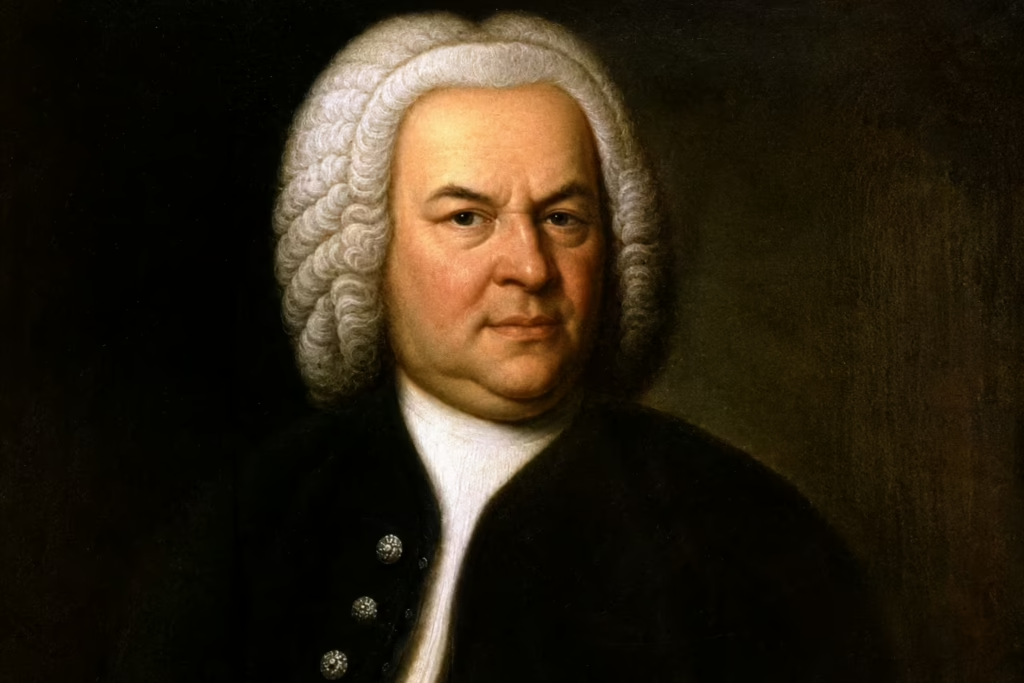
He was born on March 21, 1685, in the small town of Eisenach in the Thuringia region of Western Germany, the eighth and last child in the family. At the top of a hill overlooking the town is Wartburg Castle, where Frederick the Wise gave refuge to Martin Luther — and during his time there, Luther translated the New Testament. Down at the bottom of that hill is St. George’s Church, where Luther preached, and from there he was called to the famous Diet of Worms to defend the Christian faith. All of that is just to point out that, as someone has said, almost literally from cradle to grave, Bach lived and worked in a part of the world where Luther’s influence was a great deal more compelling than gravity.
He wanted music, as I’ve said, to glorify God — not, as the Enlightenment defined it, as “the art of pleasing” or “an innocent luxury.” By the way, he had many children, and they found that the easiest way to wake their father in the morning was to go to the piano and play a line of music he had written — but leave the last note off. Bach could not lie in bed without it being completed; they knew he would get up, go to the piano, and finish what they had started.
When he was 48, Bach acquired a copy of Luther’s three-volume translation of the Bible. He pored over it as if it were a long-lost treasure. He underlined passages, corrected errors in the text and commentary, inserted missing words, and made notes in the margins. Near 1 Chronicles 25, which lists the Davidic musicians, he wrote, quote, “This chapter is the true foundation of all God-pleasing music.” At 2 Chronicles 5:13, which speaks of the temple musicians praising God, he wrote, “At a reverent performance of music, God is always at hand with His gracious presence.” As one scholar put it, Bach the musician was indeed, quote, “a Christian who lived with the Bible.” Besides being the Baroque era’s greatest organist and composer, and one of the most productive geniuses in the history of Western music, Bach has been called a theologian who happened to work with a keyboard.
The famed violinist Joshua Bell said this about just one piece of Bach’s music — the Chaconne, from Bach’s Partita No. 2 in D Minor — that it is, quote, “not just one of the greatest pieces of music ever written, but one of the greatest achievements of any man in history. It is spiritually powerful, emotionally powerful, structurally perfect.”
I don’t know whether you’ve read any of the writings of the brilliant Peter Kreeft of Boston College, but in his Handbook of Christian Apologetics he lists twenty arguments for the existence of God. I found it intriguing that he listed this as number seventeen — the argument from aesthetic experience: “There is the music of Johann Sebastian Bach; therefore there must be a God.” He added, “You either get this or you don’t.” I read some time ago — I don’t know if it’s still going on — that Bach’s music has been used in Japan as an incredible magnet, drawing people to read the Bible and find out what inspired him to write some of the massive pieces he wrote that dealt with Bible text and Bible stories.
“Jesus, Help Me”: Two Kinds of Rescue
I don’t want to put you all to sleep, so let me stop there and look at how this applies to you and me. I’m thinking particularly of those two initials at the beginning of many of his compositions: “Jesus, help me.”
Just think of two scenarios. Imagine you’re carrying a large, heavy package up the stairs and you feel it slipping from your grasp, and somebody’s coming down, so you say to that person, “Help me.” That person grabs the other end, you’re able to re-grip the package, and the two of you carry it upstairs and set it down. You asked for his help, and that person helped you. That’s scenario number one.
Now think about scenario number two. You’re poised at the fifth-floor window of a hotel. Flames have cut off your escape route. Smoke is billowing from windows all around you. The elevators don’t work; the fire is charging up the stairwells. You’ve already blocked the base of your door, trying to keep the smoke from getting in. You have no way to get out. You’re at the window. You see a fireman putting the ladder up, and you call to him, “Help me.” The fireman, at the risk of his own life, climbs the ladder, reaches where you are, pulls you to safety, and carries you down.
It would only be by an incredible stretch of linguistic gymnastics — and a bit of hubris — if you said, “The fireman and I saved you,” the way you might say the man who helped you carry the package meant the two of you got the job done. You called to the fireman, “Help me.” You had no intention of meeting him halfway. He came to where you were, and by helping you, he saved you.
That second scenario is much more akin to what the Bible is telling us — and we read that in Romans 5: when we were yet without strength, when we were helpless, Christ died for the ungodly.
Totally Without Strength
I think it’s interesting that there are two people in our King James Version who use that very word — “help” — and called to the Lord Jesus for help. One was a father crying for help for his boy; one was a mother calling for help for her daughter. In each case, the father, the mother, the son, and the daughter — everybody involved was helpless except for the Lord Jesus. They weren’t asking for a little assistance from Christ. They weren’t saying, “I’ve done as best I can, and I’m going to do a few more things for my daughter — I’d just like you to add what you can do.” They were absolutely, totally, completely powerless, and they were crying to the Lord Jesus that He would step into this hopeless situation with the help, power, and strength that only He could bring.
So I want you to think of the fact that you and I, spiritually speaking, are described in the Bible as being helpless. “When we were yet without strength, in due time Christ died for the ungodly.”
“O Wretched Man That I Am”
Now, I think I should confess to you that I grew up hearing verses like that, and hearing preaching that told me I was helpless and could do nothing to save myself — and I never really believed it, until the night I tried to get salvation and discovered I had no idea how to be saved. I computed once that I must have listened to two thousand gospel presentations before it actually dawned on me that I cannot save myself and I do not know how to be saved. That is why I read to you this story about the disciples in the boat — because I want you to think about this concept of being helpless in the midst of contrary conditions.
There was a man in our Bible who was a Bible scholar, a rabbi, a moral, living man — a member not only of the only God-given religion the world has ever known, but of the strictest section of that religion. And yet that was the man who one day said, in one of the most poignant statements in the whole of the Bible: “O wretched man that I am! Who will deliver me?”
This was a moral, religious, refined, educated man, and yet he is using a word that means he was totally exhausted — that’s the idea behind the word he picked. He was thoroughly worn out with this battle against his sins, and no matter what he tried, he couldn’t stop himself from doing wrong at different times; and no matter how much good he did, there were other parts of his life that he knew were wrong. So he said, “Oh, exhausted man — wretched man that I am — who shall deliver me?”
I think there’s a great lesson to be learned there, because he doesn’t ask, “What shall I do?” but “Who shall deliver me?” He’s gotten beyond the idea that there’s something he can do that will rescue him from his sins. He’s come to the point where he realizes, “I can do nothing; I need someone to deliver me.” And he gives the answer in the next verse: “I thank God — through Jesus Christ our Lord” — that He is the great Deliverer.
Now think of those disciples in the boat, because they remind us that we have a woeful inability to live as we ought to live. We may achieve our own standards; we may match up, we think, with what we consider all right. But we’re not going to be judged by our own standards.
Whose Standard Will You Be Judged By?
We are not going to be judged by the standards of the society we lived in, whatever that time frame might be. When you stand before God, He isn’t going to take into consideration what most people in the year 2024 believed, and judge you by that standard.
There was a woman — I won’t give you her name — in the Pittsburgh, Pennsylvania area who beat her three-year-old child until he was deaf, blind, and crippled. When she stood before the judge at the end of the trial, and he announced how long she’d go to prison and that the child would be removed from her permanently, she said to the judge — and I’ll give you her words, poor English and all — “You guys are so unfair.” You see, by her standard, she hadn’t done anything that should require her to go to prison or lose her son. But the judge was not gauging the severity of her crime by what she thought was bad.
I’m afraid I can tell you about Americans — I can’t say as much about Canadians — but I can tell you that Americans are rapidly losing any consciousness of the overwhelming holiness of God: this infinite being who called everything into existence, this person without whom nothing would exist. That’s the person we must one day stand before — or, to use that wonderful phrase in the Bible, He is “the God with whom we have to do.” Not your standard, not my standard, not society’s standard — our life will be held up against Him, and we have a woeful inability to live according to God’s standard.
Sin Requires a Payment
You’ll notice this total insufficiency on our part to pay for our sins. I don’t know how many people today, throughout the English-speaking world, have repeated the Lord’s Prayer — but of course, that prayer, as it’s called, was a prayer that saved people were being taught to pray. So when a person says, “Forgive us our sins, as we also forgive those who are indebted against us,” those are words that can be used by people who are already forgiven judicially and on the way to heaven. But for people who are not saved, nothing we can say, nothing we can give, nothing we can suffer is going to make up for, or pay for, or wash away our sins.
That is why God painstakingly taught His ancient people, the Jews, that sin requires a payment — and that payment was death. We are helpless to put away our own sin. This is why Moses enunciated this changeless principle: “It is the blood that makes atonement for the soul.” Apart from the precious blood of Christ, as the New Testament describes it, nothing can wash away our sins. We are helpless.
Trapped for 36 Hours: Ed’s Story
Some years ago — twenty years ago now — I’ll just give you his first name, since this is being recorded — there was a man named Ed. He was a 46-year-old man driving down a highway in Texas, near Houston, and he was in a fender-bender; the two cars pulled over. Now, on many highways, what I’d be accustomed to — and maybe you would be too — is one barrier between the northbound and southbound traffic. But on this highway there were two: what they call Jersey barriers, concrete barriers, with a space in between. And when they were going to exchange insurance information, the two men stepped between those barriers.
All I can do is infer from what must have happened, because when they stepped between those two barriers, Ed did not realize that in the accident his neck had been damaged. I can’t tell you why it was a delayed reaction, but when they stepped between those barriers, he collapsed. So I’m left to infer that the other man thought, “Great, I’m out of here,” got his insurance information, jumped in his truck, and drove off. So here was Ed’s car, parked to the side, and here was Ed, lying on the grass between two concrete barriers.
A tow truck came, never saw him, hooked up his car, and towed it away. Ed’s wife came looking, searched around, looked down the other side — couldn’t find him. The police had been there when the tow truck came and didn’t see Ed either. Ed lay there, between those two concrete barriers, for 36 hours. He couldn’t be heard because of the noise of traffic; he couldn’t be seen because of the concrete barriers; and he couldn’t get up. He was helpless — absolutely, thoroughly, totally, completely helpless.
It just so happened that a man driving by in a truck happened to look at just the right time — he was higher up in his cab — and he saw shoes. So he called the police. When the policeman came, he was certain the body lying there was dead, so he took something like a nightstick and poked him, and found out that Ed was alive. They got the ambulance, got him to the hospital, and Ed said, “That person who saw me — that truck driver, whoever it was — he saved my life.” Ed’s wife said, “Whoever you are, thank you — thank you for giving my husband back to me.” Just imagine lying there 36 hours, helpless.
What the Bible is trying to convey to you and me is that when it comes to putting away our sins, that’s what we’re like. We are helpless — or, to use the verse we read, we are “without strength.” We have no power to do that.
“A Wretched, Poor, and Helpless Worm”
That’s why, on the chart here, among the missionaries, there’s a man I admire greatly, who labored all of his adult life in India, went as a missionary, and never came back — just stayed there and worked. His name is William Carey. The headstone placed on his grave — he was the one who instructed what it was to say. It started off with his name, William Carey, and the date of his birth: August 17, 1761, and then the word “died,” followed by a blank space where the date of his death was to be carved in. It didn’t really matter what day he died, because this was going to be true; and he had them put these words underneath the dates: “A wretched, poor, and helpless worm, on Thy kind arms I fall.” Helpless.
A Boy Who Thought He Knew How to Be Saved
So allow me to digress for a minute and tell you when I found out that I was helpless. I was brought to gospel meetings like this one — far more interesting preachers and far more interesting topics than you’re listening to tonight — and I had Sunday school teachers tell me about salvation. The Bible was a very respected book in our home. I remember when I was about six, I had a Bible in my hand and got angry at my sister and threw it at her, and my father took me into a side room and had a really pleasant conversation with me about never throwing the Bible again. I never did throw the Bible again, because the conversation was a bit painful. That was the kind of home I was brought up in — they loved the Lord Jesus, they revered the Bible, the gospel was everything to them.
I kind of thought there were people I knew who were really lost — that’s what the Bible calls it — and people I knew who were saved, on the way to heaven. But then there were people like me, kind of in the middle — I was really lost, because I knew the gospel, but I wasn’t really saved, because I couldn’t say I was on the way to heaven. So somehow I imagined I was just in the middle, as if there’s a third class of people in the world — when the Bible says there are only two: saved and lost. But I always thought I knew how to be saved, until a night came when I decided I wanted to be.
The Sermon That Found Its Mark
A man named Mr. Tommy Thompson, a missionary from Alaska, was traveling through on his way to South Africa, where he also had labored, and he stopped in a town in Pennsylvania because there was a family from Alaska who had moved there and he was stopping to see his friends. So on a Sunday night he was preaching the gospel. I don’t remember where he read, I don’t remember his points, I don’t remember the title of his message — I don’t remember anything about it except that at some point in his preaching he quoted 1 Timothy 1:15: “This is a faithful saying, and worthy of all acceptation, that Christ Jesus came into the world to save sinners, of whom I am chief.”
Sitting back there, the thought came into my mind: “I know that verse — I know Christ came to save sinners. Well, I’m a sinner, but I’m not saved.” As simple as that thought process was for a fifteen-and-a-half-year-old boy, it turned me to the Bible, and I began to turn to verses I had heard people quote when they told how they were saved. I heard them talk about putting their name in a verse, and it sounded very personal, so I tried that — I would read something like, “God so loved me that He gave His only begotten Son, that if I would believe in Him, I would not perish, but have everlasting life.” Nothing happened.
I heard people tell how they were saved, and they’d say they got to a point where they realized they were the worst sinner in the world, so I tried to tell God that — nothing happened. I remember people saying they got to the point where they realized they were going to hell and deserved it, so I gave that a shot and told God that too — and the next thing I knew, the preacher was saying, “Shall we pray?” and I looked up. I couldn’t believe it. I had actually wanted to be saved. I had put in a good twenty minutes or more trying to get salvation from the Bible, and the meeting was closing, and all my little ideas about what you do to become saved — they had failed.
The Night Everything Changed
And then there came roaring into my soul — carving its way into my mind, etching itself on my heart — a word from the Bible. For the first time in my life I realized: you are lost. You are lost, you are not saved, and you do not know how to become saved.
Now, there was a man on the chart here who used a very interesting phrase to describe that kind of experience. He talked about “the inundation of the Eternal” — like being swamped, like a flood hitting a person. That’s how Luther described it, and I was overwhelmed to find out, for the first time in my life, that I had no idea how to be saved. You see, I had put it on a shelf — there were times I just simply thought, “Well, I don’t want it now, but the day I want it, I know exactly where it is and how to get it.” But now the shelf was empty, and here I was — the meeting was done, I had tried everything, and I was lost. That was the night I found out I was absolutely helpless.
All I could think to myself was, “Maybe if I get home, maybe if I just get alone with God, maybe He’ll have mercy, maybe He’ll show me how to be saved.” I’d estimate it was about a quarter to ten that night, bowing beside my bed. I hadn’t been in the habit of praying, but I remember I kind of blurted it out that night — I just said, “God, I don’t want to go to hell — would You please save me?” I didn’t even know to say “Amen,” but those words were hardly out of my mouth — let me stop a moment here, for those of you bringing children to Sunday school and wondering if it’s really worth it — what came into my mind right at that moment was something I’d learned in Sunday school: “He that believeth on the Son hath everlasting life.” That’s pretty simple, isn’t it? “He that believeth on the Son hath everlasting life.”
Now, up until that moment, my idea of “believing on the Son” was that God was watching me — the spotlight was on me — and God was waiting for me to make the right move, to believe strongly enough, or hard enough, or in the right way, and the moment I did that, God would say, “Good — now I can take your faith and give you My salvation, and you would have finally done it right.” And yet right there on my knees, with the Bible sitting on the side table, I was just reaching for it when those words came into my mind, and all I can tell you is how simple it was — it just suddenly dawned on me: the salvation was Christ, not “Him and me.” Not a joint effort between the two of us where He did so much and now God is just asking me to do my little part, and God will put the two together and we’ll be saved. No — no, it’s the Son. It’s Christ. It’s the Son of God who is salvation, and if I would have Him, God would have me.
I thought to myself, “It can’t be that easy — I mean, all I found out was that because He died for me, He’s all I need.” But I told you the Bible was right there, and I was just reaching for it, so I took it, opened it up, and turned to John chapter 3 — no, I didn’t look at verse 16, I went all the way down to verse 36 — and when I saw it in black and white, right in the Book of God: “He that believeth on the Son hath everlasting life.” I thought to myself, “No — it is that simple, because that’s what God says.” I was helpless, but He’s a mighty Saviour.
Who Is This Man Walking on the Water?
I want to point out to you that in this picture of helplessness — the disciples in the ship, the Lord Jesus coming to help them — they misunderstood Him. It was between three and six in the morning, and they didn’t know who this was who was coming. A lot of people in the world are confused about who the Lord Jesus is. They think, well, He was a very good man, nothing more; He was a good teacher; or they’ll say He was a good example to us, that He showed us how to live, how to die, how to be faithful to what you believe. Come to the Bible, and you’ll find that He is God’s eternal Son, that He is the Creator of heaven and earth, that He came into the world to save you. They didn’t know why He was coming to them — they cried out in fear, thinking it was a phantom, some kind of spirit approaching them through the storm. And still today, people misunderstand why Christ came into the world.
Why Christ Came
So let’s allow Him to speak. Let’s allow Him to tell us why He came into the world. He tells us, for instance, that He came to give His life a ransom for many — that His death is the payment that enables God to rescue you. He says He came to call sinners to repentance; He is the one who presents our true condition and calls us to honestly face, before God, our sinfulness and our helplessness. He says He came to seek and to save that which was lost. We are like a wandering sheep, helpless to save ourselves; He came as the loving Shepherd, to give His life for the sheep, to find us and deliver us from an eternal danger. And He came — this is an amazing statement — He said He did not come to destroy men’s lives, but He came to save men’s lives. He wants to save you not only from hell and from judgment; He wants to save you from the warping, distorted, destructive power of sin in this life, and its eternal effects in the next. He wants you to have life — life indeed, He called it — abundant life, eternal life, everlasting life. That’s what He wants you to have.
Tony and the Torn-Up Gospel Paper
I had a friend, years ago — an old Italian man. When he had come to North America, his spiritual adviser had warned him that there might be people who would try to convert him away from the religion of his fathers, and he should be very careful about that. One day, Tony was working what they call the graveyard shift — 11 to 7 — and as he was waiting for the bus to go home, tired and hungry, a Christian offered him a gospel paper. Tony remembered the advice, but he didn’t want to be rude, so he took the paper. When the man was out of sight, he ripped it up — but he didn’t want to litter, so he put the pieces in his pockets, half in one side, half in the other, went home, and went to bed.
Sometime later, it was a rainy, kind of miserable morning — it had been a long shift, Tony was tired and hungry, and he was standing under an overhang to stay out of the rain. There was a bakery nearby, and the smell of fresh bread was wafting out. Tony was starving, but it was cold and rainy, so he put his hands in his pockets and felt something. He pulled out these pieces of paper and saw the words “bread” and “life.” So he put the pieces back and went home; instead of going to bed, he pulled all the pieces out and put them back together, and he read about the Lord Jesus as the Bread of Life, and about the fact that the Lord Jesus can satisfy, and save, and give a person eternal life. When Tony read that ripped-up gospel paper that he had reassembled, he simply took in that wonderful message — that Christ had come to give him life.
Able, Mighty, Willing, and Ready to Save
You’re helpless. You cannot save yourself, no matter how much you learn, no matter how much you grasp of the Bible, no matter how long you live — you will never be able to put away one of your sins. There is a mighty Saviour, and He came to those disciples to rescue them. He is the all-sufficient Saviour; He takes hold of Peter, keeps him from sinking, makes sure the disciples in the ship are saved.
I just want to close by giving you four of His titles, because you and I are helpless to put away our sins, but He is able and mighty to save. There has never been a sinner who has ever turned to the Lord Jesus who has been too sinful, too dark, too far, too alienated, that He cannot save that person. He is able to save; He is mighty to save. You are perishing, but He is willing to save, and He is ready to save. So the question is: will you come to Him tonight as a helpless sinner, and allow this almighty Saviour to rescue you from going down to the pit, to save you from your sins, and to give you everlasting life — if you will? This is what He says: “The person who comes to Me, I will in no wise cast out.” I hope you’ll come to Him tonight, and prove His power to save.
Sources and Further Reading
This page preserves the wording of the original spoken message. A few historical details mentioned in the sermon benefit from additional context:
- Bach’s birth date: Johann Sebastian Bach was born in Eisenach on March 21, 1685, according to the calendar then in use there. In the modern Gregorian calendar, the equivalent date is March 31, 1685. The Bach-Archiv Leipzig retains the traditional March 21 date in its chronology. Bach-Archiv Leipzig: Johann Sebastian Bach — A Chronology
- Bach’s annotated Bible: The three-volume Bible discussed in the message is more precisely known as the Calov Bible. It combined Martin Luther’s German Bible translation and writings with commentary compiled by Lutheran theologian Abraham Calov. Bach acquired his copy in 1733 and made numerous handwritten annotations and markings in it. Concordia Seminary: J. S. Bach — New Light on His Faith
- Martin Luther, Worms, and the Wartburg: The sermon compresses the chronology surrounding Luther’s connection with Eisenach. Luther appeared before the Diet of Worms in April 1521 and, after departing Worms, was taken into protective hiding at Wartburg Castle near Eisenach on May 4, 1521. There he lived under the name “Junker Jörg” and worked on his German translation of the New Testament. Lutherhaus Eisenach: Martin Luther in Eisenach