
The God who created the universe is not distant or indifferent. The Bible presents a God who deals with people personally — who speaks to individuals, cares about them, and calls them to respond to the gospel.
18 mins
Taking Jesus at His Word: The Nobleman’s Son in John 4:46–54
What does it mean to take Jesus at His word? John 4:46–54 tells how a royal official believed Christ before seeing the outcome—and what that means for saving faith.
Summary
Key Moments
Key moments from this message
The moments where Scripture opened and the gospel came clear — each with a short clip you can share.
-
01
The God of the Universe Cares About You
-
02
Would You Believe Jesus If You Saw Him
Would seeing Jesus with your own eyes make you believe?
Many people in Jesus’ day saw Him, heard Him, and spent time in His presence—and still refused to believe. Others simply heard His word, took Him at His word, and believed.
This gospel short considers an important lesson from John 4: *Christ’s word is as trustworthy as Christ’s presence*. True faith rests on what Jesus has said.


Full transcript of sermon
Scripture Reading: John 4:46–54
So I want to read with you tonight in John’s Gospel, chapter four, and we’re going to read near the end of this chapter — from verse 46 through to verse 54.
So Jesus came again to Cana of Galilee where He had made the water wine. And there was a certain nobleman whose son was sick at Capernaum. When he heard that Jesus had come out of Judea into Galilee, he went to Him and implored Him to come down and heal his son, for he was at the point of death. Then Jesus said to him, “Unless you [people] see signs and wonders, you will by no means believe.” The nobleman said to Him, “Sir, come down before my child dies!” Jesus said to him, “Go your way; your son lives.” So the man believed the word that Jesus spoke to him, and he went his way. And as he was now going down, his servants met him and told [him], saying, “Your son lives!” Then he inquired of them the hour when he got better. And they said to him, “Yesterday at the seventh hour the fever left him.” So the father knew that [it was] at the same hour in which Jesus said to him, “Your son lives.” And he himself believed, and his whole household. This again [is] the second sign Jesus did when He had come out of Judea into Galilee.
John 4:46–54
Personal Encounters in John’s Gospel
If you read through the Gospel of John, one of the things that I think is striking about it is the number of personal encounters that people have with the Lord Jesus.
It starts in chapter one. We read of a man, Nathanael, who’s brought to the Lord Jesus, and he is skeptical. He wonders if anything good can come out of Nazareth, the town where Jesus was raised. But he has an encounter with the Lord Jesus, and he’s left somewhat awestruck by this person who knows all about him.
You come to chapter three and you read the story of a religious leader named Nicodemus, who came to the Lord Jesus wanting to know more about Him — about His miracles, about His teaching. And he had a very surprising encounter with Him. He discovered that he needed to be born again.
If you go to this chapter that we’ve read — we didn’t read the first part of it — but we have the story there of Jesus encountering a woman at a well in Samaria, telling her about living water and also revealing to her His knowledge of her own life.
And so all these individual encounters, I think, are a reminder to us that the God we’re speaking about tonight is a personal God, and He wants to have a personal relationship with you. So what we’re speaking about tonight in the gospel message is something very personal, very individual. And I think it’s amazing to stop and consider that the very God of heaven, the God of the universe, the One who created all things, actually wants to speak to you. He wants to deal with you individually tonight. He cares about you.
And I think we see that again in the story we’ve read here, because we’ve read about another individual — this nobleman who comes to encounter the Lord Jesus.
The Story Recap: A Father’s Desperate Journey
So just to recap the story we’ve read: Jesus is back in Cana of Galilee. This is the place where He did a miracle of changing water into wine at a wedding feast. And in another town, Capernaum, there’s a nobleman — some kind of official, perhaps in the royal court, someone pretty important. But his status in life didn’t change the fact that his son was sick. There was nothing he could do about it. He had presumably tried whatever was within his power to help his son, but the boy was still at the point of death.
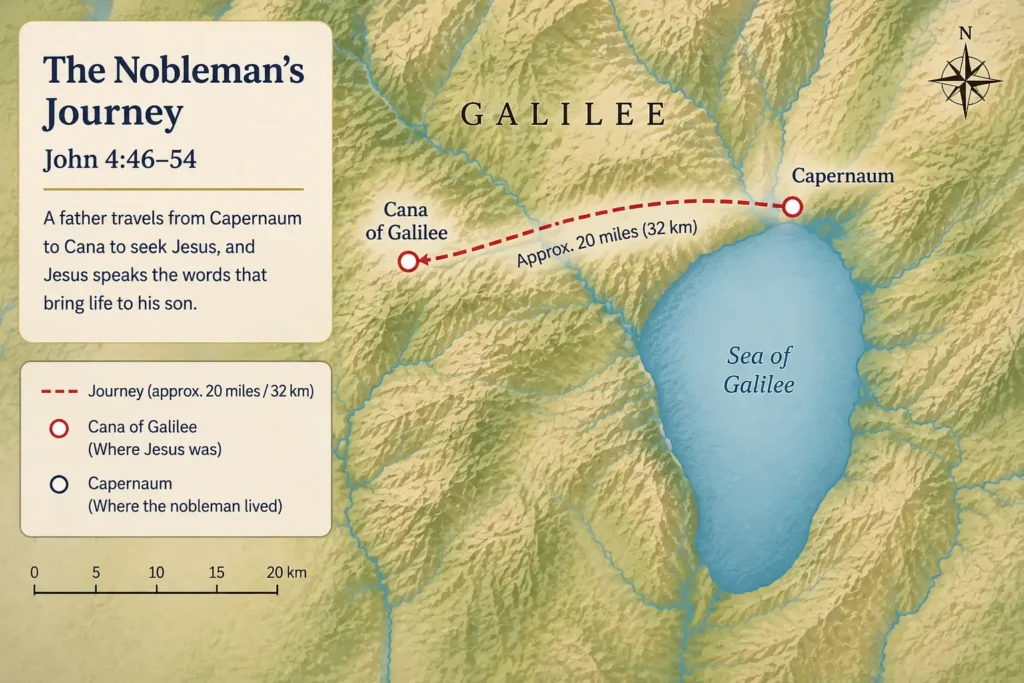
He had heard about Jesus, and he knew Jesus was now down in Cana of Galilee, which wasn’t too far from where he was — about twenty miles. So he made the trip down to Cana, and he implored Jesus to come back to his town with him to heal his son, because he was at the point of death. And Jesus says to him — and He really is saying this not just to him but to all the people listening — “Unless you people see signs and wonders, you will by no means believe.” And the nobleman simply says, “Sir, come down before my child dies.”
And Jesus says something to him very surprising: “Go your way. Your son lives.” And it says the man believed the word that Jesus spoke to him, and he went his way.
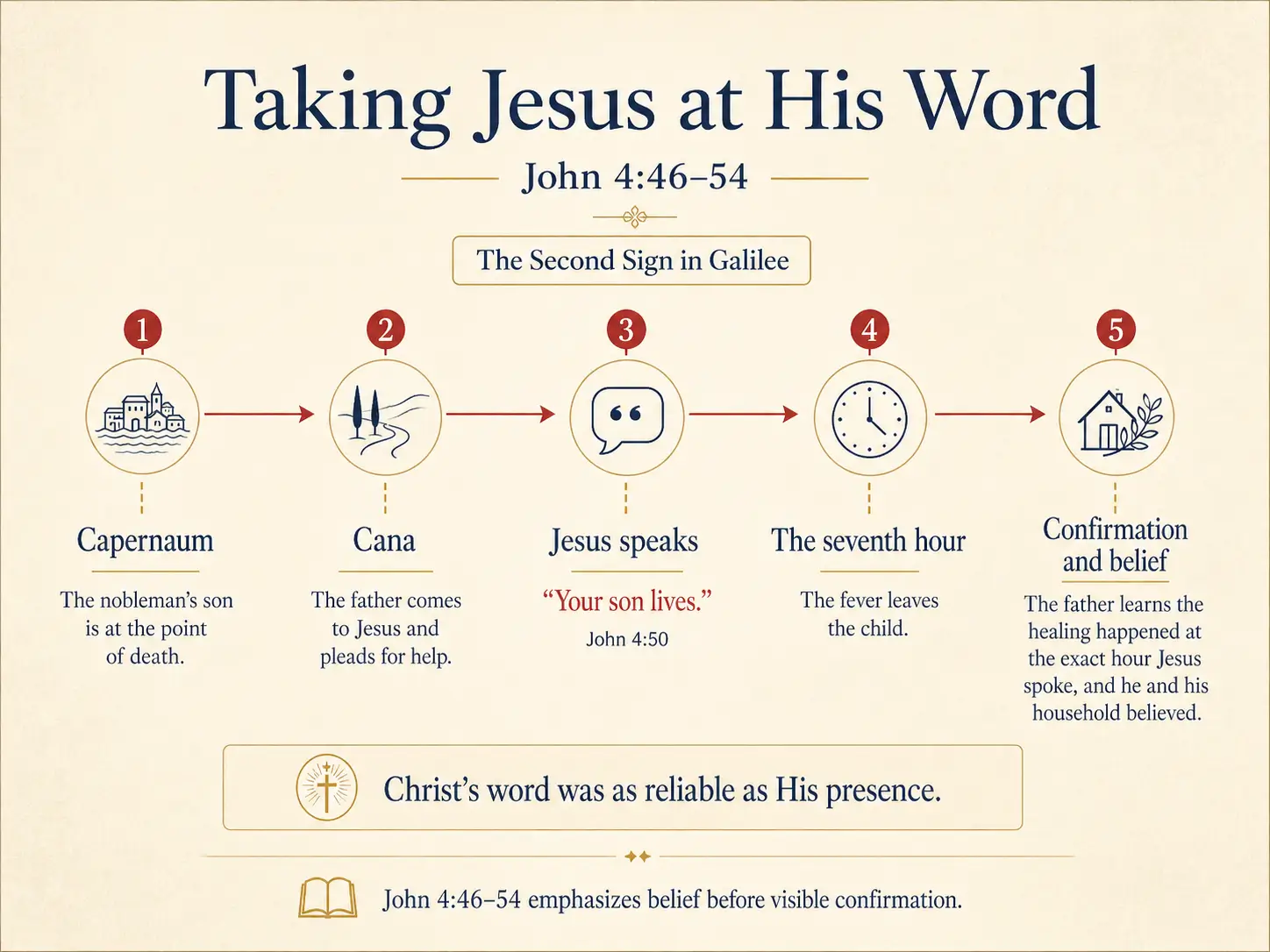
This is very significant, because Jesus has just talked about people who won’t believe unless they see signs and wonders — and here is this man simply taking Jesus at His word. When Jesus says, “Your son lives,” he takes that and goes on his way. The story finishes with him heading home; it appears he may have stayed overnight somewhere, because it’s the next day by the time he gets home. His servants couldn’t wait for him — they come out from his house to meet him on the way, and they say those words: “Your son lives.” What joy in that man’s heart! He realized that what Jesus had said was true.
No one had asked him when the boy got better, and the servants said it was yesterday, at the seventh hour, when the fever left him. And the nobleman realized this was exactly when Jesus said those words, “Your son lives.” And again we read: he himself believed, and his whole household.
Taking Jesus at His Word
So the focus of my message tonight is very simply on believing the words of Christ. I think you’ve seen it in the story — we learn an important truth, that Christ’s word is as good as Christ’s presence. And I think that’s important for us to understand, because we have the idea sometimes that if Christ were physically here — if He were to walk in the door and come here — that would change everything, right? That maybe if you don’t believe now, you would believe if you actually saw Him physically here in your presence.
But the testimony of Scripture is that this isn’t necessarily true. There were people in Jesus’s day who spent time with Him, saw Him, and did not believe. But there were other people who heard His word, took Him at His word, and believed Him. That’s what we’re looking at tonight in this story — this man who simply believed the words of Christ.
So I want to think about just two simple thoughts: first, this man’s seeking out Christ, and second, believing the words of Christ.
Point 1: Seeking Out Christ
It’s obvious that this man has a great need. Anyone with children knows that if you have a sick child — especially if it’s not just a common flu or cold, if there’s something more seriously wrong — it’s very distressing. It’s very stressful on parents, especially if you feel this powerlessness. You can’t fix it. You can’t make it well. Money doesn’t fix it. Maybe doctors can’t fix it. And that’s what this man is facing — the reality of living in a broken world where children get sick.
Sin and its effects don’t distinguish between people who are important and people who are insignificant, rich or poor. It doesn’t matter. These effects of sin are everywhere and affect everyone. This man obviously had servants; he was wealthy. But it didn’t change the fact that he could not make his son better.
It makes us step back and think about the fact that there are all kinds of problems in the world, and all kinds of problems in our lives. And it’s worth asking ourselves: why is that? Why is the world this way? And why am I this way? The world isn’t as it should be or could be. And if we’re honest, and we look inside our own hearts, we realize that I’m not what I should be or could be.
Why Is the World Broken?
How do we account for the condition of the world the way it is? Why do children get sick? Why do people fight with each other? Why is there such strife and violence in the world?
Mike spoke a couple of weeks ago and mentioned the song by John Lennon, “Imagine” — imagining a world where there’s no sadness, sorrow, or suffering. It seems simple enough: why can’t we just all get along? The prescription of that song is that if we just abolish religion, and abolish countries, and abolish personal property, we would have some kind of utopia. But of course, the record of the twentieth century shows that doesn’t actually turn out so well. There’s a sad history of people trying to bring that about.
So we’re confronted with this problem, and it should pose a question in our minds: why is the world like that?
Sin, Judgment, and the Reality of Hell
The Bible has an answer for that. The answer of the Scriptures is that we have rebelled against our Creator. Human beings have defied and disobeyed the One who made us. We’ve tried to cut Him out of our lives. We’ve tried to pretend He doesn’t exist. And we’ve paid a heavy price for that.
The Bible calls this sin, and it tells us very plainly that we are all sinners. We’ve all gone astray. We’ve all gone our own way, and it hasn’t gone well. The evidence for that is just looking around in the world tonight.
But the Bible takes it further. It doesn’t just explain why the world is the way it is — it says it’s going to get worse. There’s worse to come, in terms of what lies ahead of every individual if we continue on this way. The Bible speaks about coming judgment. It speaks about a God who is holy, and a God we have to face — and to face Him in our sins is something unimaginable. To stand before the living God with your own sin, not dealt with, is a tremendous danger the Bible warns us about very faithfully, and we want to be faithful with you tonight to warn you about that danger.
The Bible speaks about coming judgment. It speaks about hell. It’s a real place, and it’s a place you don’t want to go to.
So that’s the condition we live in. This is the problem we face. We live in a world where kids get sick. Sometimes children die. Fathers and mothers search desperately for anything or anyone who can help prevent this.
So maybe tonight — hopefully you don’t have a sick child — but maybe your life in general just hasn’t gone the way you planned. It hasn’t turned out quite how you expected. And maybe God is trying to get your attention tonight and make you realize that there is sin in the world, and, in fact, there is sin in your heart and my heart.
I wonder if you’re seeking tonight. Sometimes affliction like this, sometimes trouble, can drive us to ask deeper questions and start searching. And that’s our prayer — that you would be searching. This man’s search for a cure for his son led him in the right direction. He’d heard about Christ, probably heard about His miracles, and now he was going to seek Him out.
The Nobleman Believes Before He Sees
This man had certain expectations about how Jesus would heal his son. I’m sure he expected Jesus to come with him back to Capernaum, where he lived — that Jesus would come into the house, go to the room where the child was, maybe say some words or touch him, and the healing would take place. You can just imagine him on his trip from Capernaum to Cana to find Jesus, going over in his mind: How am I going to get him there fast enough? Will He be willing to ride horseback with me back to Capernaum? What if He’s in the middle of a teaching session — I’ll have to wait till that’s done. How long will it take us to get back there? Will we be in time before my son dies? All these things swirling around in his mind about how it’s going to work.
But notice that the Lord Jesus doesn’t follow his expectations. To this man’s great surprise, Jesus simply says to him, “Go your way. Your son lives.”
I think it’s to this man’s great credit that he doesn’t question the Lord Jesus. He doesn’t protest. He simply takes Him at His word. And that’s what we read here: “Go your way, your son lives” — and so the man believed the word that Jesus spoke to him. That’s the key text I’ve pointed out for you here.
Notice that he has no proof that this miracle happened. He can’t text his wife or call and ask if there’s any improvement. He has no idea. He simply has to rely on the words of Christ. And to his credit, he takes those words at face value, and he believes what the Lord Jesus has told him.
Taking God at His Word
I think there’s an analogy tonight for people who come to Christ for salvation. Salvation involves taking God at His word. And when I say the words of Christ, I don’t just mean if you have a Bible with the words of Christ in red letters — I mean the whole Bible, because really the whole Scriptures are the words of Christ, the words of God to you. What God is asking you is simply to take Him at His word and believe what He says.
When a person comes to faith in Christ, that’s what they do — they believe the words of the Lord Jesus and make those things their own. They don’t always immediately feel different. There can be a delay between the believing and the reality of that being worked out in your life as a believer. Sometimes that leads people to question: did I really get salvation or not? But the test for that is very simple. You just go back and ask, did I take Christ at His word? Do I believe what He said in the Scriptures? And if a person has done that, then the change will take place in their life. It will happen.
I can just imagine this man on his trip back home, saying those words over and over to himself in his mind — the words of Christ: “Go your way, your son lives, your son lives, your son lives.” Any time he wondered, or had fear, I’m sure those words came back to his mind. And I think those of us who are saved, who have had an experience of salvation — there may be particular words the Lord used to bring us to faith in Christ, and those words come back to our minds. We rehearse them again because we’re saying, that’s what I’m trusting in — the words of Christ. Those are reliable words.
So this man has to wait till he gets home, the next day. The servants can’t wait to tell him, so they come out to meet him with the news. It’s interesting — they use exactly the same words the Lord Jesus used. They tell him, “Your son lives.” And he asks them, when did he start getting better? When did the fever leave him? And it was the seventh hour of the previous day. So he knows exactly when Jesus said, “Your son lives.” And then we read again: he himself believed, and his whole household.
The Deeper Problem: Sin’s Root Cause
Clearly the Lord Jesus had the power to do miracles like this, and to heal this boy. But our problem — the problem with sin — is even deeper than a problem like this. This is a consequence of sin. This is the effects of sin. And the Lord Jesus came to deal with the greater problem, which is the root cause of sin. He came to deal not just with the effects, but the very roots.
He could have healed every sick boy and every sick girl in the countryside all around there, but then there would be other children to get sick, right? It wouldn’t actually solve the underlying problem. So He came to deal with the root problem. Our great problem of sin couldn’t be solved by Christ just saying words. It involved far more than that. It required His death.
So He was on the way to the cross, to become the sacrifice for sin. The Bible says that Christ also suffered once for sin, the just for the unjust, that He might bring us to God.
A Greater Son Who Truly Died
As I finish, I was thinking about this nobleman with his son. His son was near death, but he didn’t die — and it must have been a tremendous relief for this man, for his son to live. But think about God’s beloved Son. God sent His own Son into the world, and He didn’t just come near death; He wasn’t just sick. He actually entered into death. He truly died. And in dying, He destroyed the power of death. The evidence of that is God has raised Him from the dead.
What a wonderful Savior — to have someone who has actually come into this world, come into our situation, gone to the cross, given up His life — one who has died and now lives again in the power of an endless life.
So our prayer tonight is that you’ll seek out Christ, and not only seek Him out, but believe His words. You’ll trust what He says. Remember the words of the Lord Jesus, who said, “He who hears My word and believes in Him who sent Me has everlasting life, and shall not come into condemnation, but has passed from death into life.”
Scripture taken from the New King James Version®. Copyright © 1982 by Thomas Nelson. Used by permission. All rights reserved.
Key scripture
“Go your way; your son lives.”
John 4:50
Related Messages


Questions about salvation?
If you’d like to learn more about what the Bible teaches on forgiveness or speak with someone from Ottawa Gospel Hall, we’d be glad to hear from you.