
Mary Slessor’s missionary work grew out of her Christian faith, service in Scotland, and inspiration from David Livingstone. Although her wages helped support her family, her mother encouraged her to go to Africa. She sailed in 1876 and began working at the Calabar mission. Illness temporarily brought her back to Scotland, but she returned. Wanting to reach more remote communities, she moved to Okoyong in 1888, where she endured difficult living conditions and initial hostility while continuing her work.
Galatians 4:4–5
45 mins
Mary Slessor, Missionary to Nigeria: Adoption Into God’s Family
Explore Mary Slessor’s life and missionary work in Calabar, Nigeria, including her care for abandoned twins, with a gospel message on becoming a child of God.
Message Summary
Q&A
Questions answered in this gospel message
Watch short video excerpts addressing some of the core questions from this message.
-
Question
01
How did Mary Slessor become a missionary in Calabar and Okoyong?
Key Answer
-
Question
02
What did Mary Slessor do to help children and communities in Calabar?
Key Answer
Mary Slessor helped children and communities in the Calabar region by rescuing vulnerable babies, raising children in her home, caring for the sick, and intervening against violent punishment. The sermon describes her efforts to settle disputes peacefully and prevent further bloodshed. She also encouraged trade between villages and helped establish mission stations where local Christians continued the work.
Full Sermon Transcript
Missionaries and Their Impact on World History
Good evening, and thank you for coming on this Monday night. I’ll tell you something about Monday nights: they’re a great night for somebody to be saved. I have never met anybody who was saved on a Monday night who said, “I wish I had waited until Tuesday, or Wednesday, or later in the week.” This would be a wonderful night for you to come to know Christ and be saved.
Last night, in our thinking, we went to Germany, as we considered Johann Sebastian Bach. Tonight we’re going to be looking at missionaries — and specifically at this woman here, Mary Slessor of Africa. So we’re thinking of Nigeria.
Now, you might say, “I thought the title of this series was The Impact of the Bible and Christianity on World History — and yet I’ve never heard of Mary Slessor, or some of these other people. What impact did they really have on world history?” Well, let me tell you.
When William Carey went to India, there was a practice among the people there called sati, or suttee. It involved giving a widow whose husband had just died a stupefying drink, then leading her — in a daze — onto the funeral pyre, where the body of her husband was about to be cremated, and having her lie down beside him while she was still alive, and burning her alive along with him. It was this man’s preaching of the gospel, and his fight against that practice, that led to the saving and the deliverance of so many people.
Henry Nott went to Tahiti. If you’re familiar with those idyllic pictures painted by Gauguin, it looked like an absolute paradise — until missionaries went there and, some say, “ruined their culture.” Well, when he arrived in Tahiti, here is what he actually found: elderly people, rather than being cared for, would be taken down to the beach and literally pulverized — every bone in their body broken — and then buried in the sand. He found that when enemies were defeated in battle, the victors would skin them and wear the skin like a coat. That’s what he found in that “idyllic paradise” of Tahiti.
When men such as Fred Stanley Arnot and others went to Africa, they found that if a chief died, the people didn’t want him to go into eternity alone. So they would send an escort with him — burying his slaves alive alongside him — so the chief would have people to accompany him into the next life.
And we’re going to notice tonight that this amazing Scottish woman ended up adopting a number of children, because in that culture, if twins were born, it was believed that one of them must be filled with a demon. So the babies would simply be thrown out into the jungle to die. She would adopt them — we’ll look at that in a moment.
Now, I have a number of friends of Indian and African descent. Many of them would not be alive today if it weren’t for the lives that were saved by these missionaries. If you’ve ever watched the very moving video of Sir Nicholas Winton on YouTube, you’ll know that the hundreds of Jewish children he saved during World War II resulted in thousands of people being alive today. In the same way, the hundreds upon hundreds of people these missionaries saved resulted in thousands upon thousands more who would never have lived — never have been born — if it weren’t for them. They had a tremendous impact on our world, as we will hopefully see in the nights to come.
Ephesians 2 and Galatians 3–4: Children and Adoption
There are two books from which I would like to read with you tonight. The first is the book of Ephesians, chapter 2.
And you hath he quickened, who were dead in trespasses and sins; Wherein in time past ye walked according to the course of this world, according to the prince of the power of the air, the spirit that now worketh in the children of disobedience: Among whom also we all had our conversation in times past in the lusts of our flesh, fulfilling the desires of the flesh and of the mind; and were by nature the children of wrath, even as others. But God, who is rich in mercy, for his great love wherewith he loved us, Even when we were dead in sins, hath quickened us together with Christ, (by grace ye are saved;) And hath raised us up together, and made us sit together in heavenly places in Christ Jesus: That in the ages to come he might shew the exceeding riches of his grace in his kindness toward us through Christ Jesus. For by grace are ye saved through faith; and that not of yourselves: it is the gift of God: Not of works, lest any man should boast.
Ephesians 2:1-9
Now, in the previous book, Galatians chapter 3 and verse 22:
But the scripture hath concluded all under sin, that the promise by faith of Jesus Christ might be given to them that believe. But before faith came, we were kept under the law, shut up unto the faith which should afterwards be revealed. Wherefore the law was our schoolmaster to bring us unto Christ, that we might be justified by faith.
Galatians 3:22-24
And just the next chapter, for our final reading — chapter 4 and verse 4:
But when the fulness of the time was come, God sent forth his Son, made of a woman, made under the law, To redeem them that were under the law, that we might receive the adoption of sons. And because ye are sons, God hath sent forth the Spirit of his Son into your hearts, crying, Abba, Father.
Galatians 4:4-6
Mary Slessor: From Scotland to Calabar
Mary Slessor was born on December 2, 1848, in Aberdeen, Scotland. She trusted Christ through the loving witness of an elderly woman who had a concern for the souls of Mary and her friends. By the time she was eleven years old — and I think the children here should listen carefully to this — Mary was working twelve hours a day in a factory to help support her family.1 Nevertheless, she always found time for evening Bible classes and Sunday school, as well as witnessing for the Lord Jesus to people in her community.
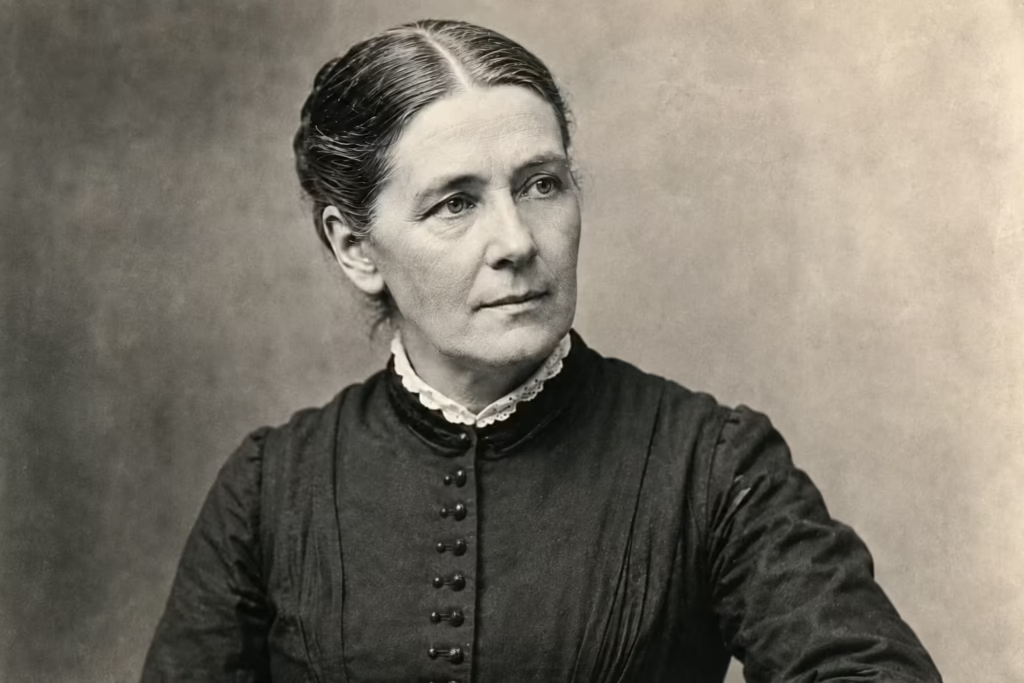
Inspired by David Livingstone’s example, she felt a growing burden for Africa. One of her main concerns, of course, was leaving her family, because her factory income was an important part of their support. Her father was a drunkard, and family life was very difficult, but Mary’s mother encouraged her to go. Mrs. Slessor was a strong supporter of missionary work; she had lost two sons whom she had hoped would go to the mission field. So she encouraged Mary, and on August 5, 1876, with her mother’s blessing, at the age of twenty-eight, Mary sailed for Africa.
Called to Calabar
Her first station was at the already-established Calabar mission. Although she had experience working among the poor in Scotland, nothing could have fully prepared her for the conditions she found in Calabar. Superstition, witchcraft, cruelty, sorcery, and bloodshed were widespread. The killing of twins — because it was believed that one of them must have an evil spirit, though no one knew which one — and the banishment of the mother to the bush, was the law of the land.
Mary spent three years at the Calabar mission, working among the people and telling them about the Lord Jesus, her Saviour. After several severe bouts of fever, one of which was nearly fatal, she had to return home to Scotland for a brief visit to recover. As soon as she was well enough, she sailed again for Calabar.
Moving Up-Country to Okoyong
Once more she engaged in a constant battle against witchcraft, superstition, and alcoholism among the people. She continued to fight this darkness with the love of Christ and the emancipating message of the gospel of His grace. On Sundays, she traveled a circuit deep into the jungle, preaching to anyone who would listen. But always restless, she was convinced her calling was to preach in an even more remote area. So in 1888, with the help of a local chief, she moved up-country to the Okoyong district, and spent the next fifteen years laboring there.
Here is a quote from her, from that period:
“In the forenoon I was left alone with the mud and the rain and the general wretchedness. I looked helplessly on, day after day, at the rain pouring down on the boxes, on the bedding, on everything. There was no privacy. Packed tight in the tiny hut with a mud floor were two girls and three boys, as well as the locals who crowded in on every side — not just men, women, and children, but also goats, dogs, fowls, rats, and cats, all going and coming indiscriminately.”
Her initial attempts in Okoyong were met with hostility — even armed hostility — but eventually, admiring her courage for coming to them alone, she won the ear of the chief and the people.

The Practices Mary Slessor Confronted in Calabar
Now, in Calabar, the people attributed every accident or misfortune to sorcery — which meant that someone always had to be blamed for it, and punished. One biographer described it this way:
“When a chief died, dozens of slaves were killed. Unwanted babies were thrown into the bush. Twins were buried alive or thrown into the forest. Their mother was driven off to die. The tribes fought and drank. Cannibalism was often practiced. Terror stalked the jungle. A secret, masked society known as the Egbo would descend on a village and beat the people indiscriminately.”
Once, Mary showed how weak they really were by chasing off a group of Egbo and tearing the mask off one sheepish man.
Another evil she fought was the treatment of wives after a husband’s death — I hope the women here are listening. A chicken would be beheaded in front of the unlucky widow, and depending on how it flopped, she was judged either guilty or innocent of her husband’s death. The legs of “guilty” wives were broken, and the women were thrown alive into their husband’s grave. In their burial customs, wives and slaves had to accompany the deceased into the spirit world — the more important the dead man, the higher the number of people strangled at his graveside to be buried with him.
The practice of murdering twins was unthinkable to Mary, and she rescued many of these unfortunate children and raised them herself. She saved so many babies that they often filled her home by the dozens. She learned to tie a string to each little hammock and lie in bed at night, pulling the strings as each baby needed soothing.
She soon won the respect of Europe and Africa, so much so that she became the first woman vice-consul of Britain, using her position to further missionary work. For forty years, she pioneered the gospel in areas that had proved the graveyard of other missionaries. Eventually, through her example and teaching, the twin-killing ceased.2
There were also the trials by ordeal. One used the Calabar bean — a brown bean that grows in pods about six inches long. Nothing in the bean’s taste, smell, or appearance distinguishes it from any other bean; the difference is only discovered after it’s eaten, which is a very difficult way to discover it. First, the bean’s chemical increases the output of the victim’s salivary glands. Then it constricts the blood vessels leading to those glands. Blood pressure rises. Violent vomiting begins. The action of the uterus, spleen, bladder, eyes, heart, and lungs fluctuates wildly. Tremors and convulsions of the spinal cord set in. Mental functions are not affected, so the victim remains completely conscious of what is happening to him throughout the entire ordeal. Finally, the poison causes the bronchial tubes to constrict while the glands’ secretions increase — the lungs become waterlogged, and death follows almost immediately. Feeding sacrificial victims the bean, and watching the ensuing show of misery and death, was a major part of the region’s religious heritage. Quite a “paradise.”
The other method was trial by oil. In these cases, boiling palm oil was poured on the naked belly of the person accused of a crime. If it scalded him, he was guilty. If he survived, he was innocent — and there weren’t too many who survived. These trials were an almost daily affair, and Mary had to be ready day or night to leave her home and rush out to act as peacemaker before someone was killed. The people, for the most part, respected her fairness and judgment, but she was put in dangerous situations many times because of her firm stand.
While teaching Christ to these African villagers, Mary had to work to prevent tribal wars between villages, tend to all sorts of sickness and disease, prevent retaliatory killing due to superstition, and stand up to tribal chiefs to prevent cruel and unfair punishment and murder. She spent many hours seeing that disputes were settled without the usual bloodshed. Okoyong became a more peaceful place because of her influence, and many came to know Christ as their Saviour. As a result, trade between the villages — which cut down on idleness — was established through her influence. This, in turn, cut down on the use of liquor among the men and helped stabilize relations between warring villages. Mission stations were set up in many villages, and native Christians were left to tell others about the Lord Jesus. These native-run stations were largely self-supporting, which freed Mary for further pioneering work.
Mary Slessor’s Final Years and Legacy
Even in declining health, Mary continued to expand the work of God, and in each new village she had to fight the same battles against superstition, twin-killing, witchcraft, corruption, and sin. But finally, the last “heathen” village in the area asked her to come and establish a mission in their midst.
Mary Slessor went to be with Christ on January 3, 1915, at the age of sixty-six.3 She had spent thirty-nine years on the mission field in her beloved Calabar, and was buried in Duke Town, where her work in Africa had begun. Only the Lord knows how many lives were spared, and how many souls were saved, because of this little woman’s desire to bring the gospel to the lost men and women of Calabar.
On a 1956 visit to Nigeria, Queen Elizabeth II laid a wreath at the base of a large granite cross marking the spot where Mary Slessor had been laid to rest some forty years before.
At Mary’s burial, the mourners gathered — but instead of wailing, as they had done at funerals before Mary came to Calabar, before they had heard the gospel, they joined in singing: “Praise God, from whom all blessings flow; praise Him, all creatures here below.” I don’t suppose there could be a greater tribute to the life God had brought into His kingdom than people who once wailed in hopeless despair in the presence of death, now praising God from whom all blessings flow.
As you’ll understand from what I’ve just described, one of Mary Slessor’s greatest accomplishments in bringing the gospel to these tribes was the end of twin-killing.
Part of a larger series
This message is part of The Impact of the Bible and Christianity on World History, a series exploring people whose Christian faith shaped their lives and influence. You may also be interested in Fanny Crosby and the Living Words of Jesus, which considers the faith and hymns of one of Christianity’s best-known hymn writers, or Johann Sebastian Bach and the Gospel of Matthew, on the Christian convictions reflected in Bach’s music.
What Does Adoption Into God’s Family Mean?
So I’d like to ask my audience tonight: have you ever felt unloved? Have you ever felt like nobody in the world cares about you? If that’s the case, then this meeting is for you. I want you to think about that word — adoption.
Adoption is the word God uses to describe His gracious work in the lives of sinners who trust His Son. He adopts them into His family; He places them into His family. That’s why I read to you the passages we did, because I want to focus your attention on three phrases: children of disobedience, children of wrath, and children of God.
Children of Disobedience: A Look Back
Children of Disobedience: What Sin Has Made Us
So think first about the global orphanage — look at the asylum, if you will — because earth is the sad orphanage, the tear-filled asylum in which God finds those who want to become His children. And it’s an orphanage populated by the most unlikely candidates in the universe for such an incredible blessing. Why would a holy God have any interest in placing a sinner like me into His family? That’s what we’re going to look at tonight.
Now, this phrase “children of disobedience” is a look back — back to the Garden of Eden, where every one of us, speaker included, became a child of disobedience. The Bible reminds us that our first father sinned. Adam sinned willfully; he was not deceived. He walked into the trap with his eyes open. He fell — and as a result of his becoming a sinner, all of us were born sinners.
You see, if a mountain stream were polluted halfway down, then from that point on, the water would not be drinkable. But if you went above the point of pollution — from wherever the stream issues out of the mountain down to the point of contamination — that water would be clear, drinkable, potable. Sin struck at the very beginning of the human family, so that all of us are children of the disobedience. We all come into the world as sinners.
Adam sinned egregiously. He sinned against God; he sinned against light; he sinned against visible evidence of God’s power and grace. You’ve heard people say, “Well, if there’s a God — if He would just show Himself, I would believe.” God appeared in the Garden of Eden with Adam and Eve. They saw creation fresh from the hand of God. They lived in a paradise God had introduced them to. He had talked with them, interacted with them, communed with them. They knew there was a God. But when the choice came between doing what God said and doing what they wanted to do, they made the wrong choice, and Adam sinned against God.
God came down. You remember He said, “Adam, where are you?” I owe this next thought to a rabbi who pointed out something about the word God chose to record. Let me illustrate it as best I can. We have a store just a couple of blocks from us where we go for groceries — the Acme Market. My wife knows everything about that store; she knows exactly where everything is. I don’t know how women do that.
So let’s say I go with her to the store. I basically know where the front door is — that’s about it. She knows I’m maybe a bit inept, so she says, “I’ll get everything else. You just get the bread.” And I say, “Okay — where’s the bread?” And she says, “Aisle five, halfway down on the left.” So I’m wandering around the store, and being forgetful, I pick up a couple of other things, but I don’t pick up the bread. Now we’re out at the car, emptying the cart, putting it in the back, and my wife says — using the exact words I had asked her — “Where’s the bread?”
When I said, “Where’s the bread?” I was asking because I didn’t know where it was, and I wanted her to tell me so I could go get it. When she said, “Where’s the bread?” she was saying: it was supposed to be here, and it’s not — where is it?
When God said, “Adam, where are you?” He wasn’t saying, “Adam, I can’t find you — come, show me.” No. He was saying, “Adam, you were supposed to be here. Where are you?” A chasm had come. A division had come. A separation had come. And Adam was hiding from God because he had sinned against Him.
A Family Resemblance in Sin
Do you know, I think I could tell you he sinned carelessly — he wasn’t thinking about you. Adam and Eve weren’t thinking about the whole race of humanity that would come into the world twisted and warped and distorted by sin. They were just thinking of themselves. The devil had told Eve, “You’ll be like God — go ahead.” And whatever Adam’s motive was — maybe not wanting to leave Eve, not wanting her sent out without him — all they were doing was thinking about themselves. Sin is a very selfish thing. Adam wasn’t thinking about you. He sinned very carelessly, because he was only thinking of himself.
Now, if it just stopped there, it would perhaps have less bearing on us. But I want to tell you about our family resemblance, because we look just like our father. You have sinned willfully. Here’s how Isaiah puts it: “We have turned everyone to his own way; we have taken our own course.” There are times when we knew what God wanted, but what we wanted was something else — and we didn’t really care what God said at all; we just did what we wanted. We have sinned willfully. We have sinned egregiously against God. We have sinned against His Word. We have sinned against His grace. We have sinned against His Son. We have sinned against the light of truth we have in His Word. How serious it is to sin against God.
Remember when the prodigal came back? He came back with thoughts in his mind about the stark contrast between starving in a far-off land and the blessing of being in his father’s house, and he had it all worked out what he was going to say. What does he put at the head of the list? “Father, I have sinned against heaven, and in Thy sight.” He understood how egregious it was that his sin was, first of all, against God.
David understood that too. David sinned against a woman. He sinned against her husband. He sinned against his army. He sinned against the nation. And yet David said, “Against Thee, Thee only, have I sinned.” He didn’t mean he hadn’t sinned against other people — he meant that this was so overwhelming, it dwarfed and eclipsed everything else, because his sin was against God.
Have you ever come to understand how serious it is to be a sinner? We belittle it. We minimize it. We imagine sin isn’t all that serious. But we have sinned against the great God of the universe — and in some ways, we have sinned carelessly, without a second thought about the results.
I don’t want to sound harsh here, but let me illustrate. There are people listening to me remotely, and here tonight, who have made choices in life — choices about what they wanted to do — and have never thought twice about the effect on their children or grandchildren. My grandfather came from Italy. He had been in the Italian Navy, and there were two places that attracted him — Argentina and Philadelphia. I don’t know what tipped the scale, but he chose Philadelphia. What was he thinking about? “I like Philadelphia.” He came to Philadelphia, met a man named Cesare Petriccio, got a Bible, heard John 3:16 for the first time in his life, and trusted Christ — and the choice to come to Philadelphia had monumental effects on his children and grandchildren, one of whom is standing before you tonight.
On the other hand, there are people who have made choices toward drugs, toward alcohol, toward sin, toward immorality, toward dishonesty, that have had a terrible effect on their children and grandchildren. Have you? Because that’s what sin does — it makes us think only about ourselves.
The Trouble Is What We Are, Not Just What We Do
And one of the problems with sin is that our struggles against it are futile. Every attempt to conquer sin, or to somehow put our sins away, is doomed from the start. Do you know why? Because the enemy is already inside the gates. We’re not dealing with something superficial — it’s not a matter of cleaning up a few habits and then everything will be okay. The problem I had, and that you have, is that sin was inside me. It was part of my being, part of my makeup. It affected how I thought, what I wanted, what I desired, what I liked — it affected everything about me.
When you hear preachers use the term “total depravity,” they don’t mean a person is so totally wicked that he couldn’t be even more wicked — there are things I could have done that I didn’t do. Total depravity means that every part of me has been affected by my sin.
Do you remember the man who went up to the temple to pray? The Lord Jesus tells us about a Pharisee and a publican. The publican did something that seems strange to our ears when we hear it described: standing far off, he wouldn’t even lift his eyes to heaven, but he beat upon his chest, saying, “God, be merciful to me, the sinner.”
What does this mean? What is this denoting? Well, first, it has to do with ritual grief — what would happen at a funeral, how a Jewish person would mourn. It’s as if he’s mourning the death of any hope he had of being right with God. But he’s also, in effect, saying, “Here is where the problem is — it’s in here.” It’s not a matter of simply stopping certain sins. The problem is what I am — that I am a sinner. What I have done in my life, the sins I have committed, requires forgiveness, or I can never be in heaven. But what I am requires regeneration — a new birth — because of what I was as a sinner. And this is what makes sin the great problem: the stain of sin can never be put away by ourselves. We are children of the disobedience. That’s a look back.
Children of Wrath: Where Sin Leads
I read to you a second phrase. Paul says we’re “children of wrath.” That’s a look the other way — a look into the future. “Children of disobedience” reminds me that I came into the world as a sinner; that’s my nature. “Children of wrath” reminds me that, unless there’s a mighty change in my life effected by God, I’m on the way to eternal wrath. That’s my future — and that future can only be changed by the Lord.
The fact of it is given to us in the Bible. Remember how Job put it: “Because there is wrath” — got those words? — “there is wrath. Because there is wrath, beware, lest He take thee away with His stroke; then a great ransom cannot deliver thee.”
Please understand that what’s happening here in these meetings is so serious. The Christians here are so committed to presenting the message of the gospel to you, because they understand that if you miss Christ, if you miss salvation, if you’re never born again, you will face wrath eternally — and they don’t want that. God doesn’t want that. Christ came to make it possible for you to have heaven instead of hell, salvation instead of damnation. But please understand: every sin — every sin — will be punished, either punished in the person of Christ at Calvary, or punished forever in the lake of fire. That’s how serious this is.
How Christ Makes Adoption Possible
And with that judgment coming, I’m glad to tell you tonight that God has a way of taking you — a child of disobedience, a child of wrath — and making you a child of God. So I want to consider with you the wonderful truth of adoption.
This is a gracious offer. It’s possible because Christ, at Calvary, took onto Himself my disobedience. I was a child of disobedience — He took my sins onto Himself. Peter put it this way: “His own self bare our sins in His own body on the tree.” In the Old Testament, the prophet Isaiah, looking ahead, gave this prophecy: “The Lord” — that is, the Lord God — “laid on the Lord Jesus the iniquity of us all.” Isaiah says, “He was wounded for our transgressions; He was bruised for our iniquities; the chastisement of our peace was on Him, and with His stripes we are healed.” We are saved — and the New Testament puts it so succinctly and so pointedly: “Christ died for our sins.”
I’m on the way to heaven tonight because everything of disobedience and sin that was mine, that blessed Saviour took on Himself at Calvary. He answered to God — He answered to God for all of my wickedness and sin. He became my sin-bearer, my substitute. He took the judgment that should have fallen on me; He took it on Himself.
So if you’ve seen pictures of Calvary showing three crosses, let me tell you this: two of those crosses held men suffering the wrath of Rome — they were suffering for sins they had committed. The Man on the middle cross was suffering the wrath of God. He was sinless, and He was suffering the wrath of God for my sins.
Do you know it’s possible — because He endured that wrath and judgment — He did this willingly. Rome could never have put Him on that cross any more than it could have kept Him in the tomb. He did this willingly. He went to the cross and offered Himself up to God as my substitute, my sin-bearer, my Saviour.
He did this fully. He didn’t do part of the work and leave the rest for me. That’s the meaning of that wonderful statement: “It is finished.” It is paid in full. It is completed. It is fulfilled. He has done the work — and He did it finally, never needing to be repeated, in that He died under sin one time. By one offering, He has provided salvation for all who trust Him. So it is possible for you to become a child of God tonight, because the Son of God died on a cross for the ungodly.
How Do You Become a Child of God?
As Many As Received Him
So when does it become actual? How could you, tonight, become a child of God? John chapter 1 tells us: “As many as receive Christ, they become the children of God.” So let me ask you a question — this was a great puzzle to me before I was saved. If the Lord Jesus were here — and I don’t want to be irreverent — but if He were here, and all you needed to do to be saved was what Zacchaeus did, just come and throw your arms around Him and receive Him, would you do that? Would you do that tonight? Would you do that now?
Maybe some of you are saying, “I wish it were that simple. I would love to be saved tonight. If He were here and all I had to do was actually throw my arms around Him, that would be very simple — I would do that.” It’s even more simple than that.
Receiving Christ by Receiving His Word
Because, you see, Peter reminds us that a person becomes a child of God by receiving the word of God. I used to sit in gospel meetings and hear preachers quote the words of the Lord — “Come unto Me, all ye that labor and are heavy laden” — and I used to think, “Yeah, great — He’s in heaven, and I’m on earth. How do I come to Him?” You come to Him by coming to His Word. You receive the living Word by receiving the written Word.
That’s why in John chapter 4, there’s a man who receives what Christ says — “Go your way, your son lives” — and that’s the same as receiving Christ. He goes home, and the boy is alive. The way you receive the Lord Jesus is by God giving you His Word. If you receive His Word, you will be saved — and “as many as receive Him, they become the children of God.” Peter says we are “born again, by the word of God, which liveth and abideth forever.”
And simply put, here is why this is absolutely incomparable.
A New Nature and a New Place in God’s Family
Two great changes take place when a person receives Christ — when a person receives the word of God — two great changes take place that would have been impossible for you or me to bring about.
A New Nature — the Apostle Paul
First of all, when a person is born again, his nature is changed. He is given new life — called eternal life, or everlasting life. That person is not made perfect or sinless; the redemption of our bodies, when that becomes fully true, is still to come. But right now, when a person is saved, he is changed inwardly, and he is made a child of God.
Maybe the classic example of that is the apostle Paul. He hated Christ. He hated the Christians. He hated the message of the gospel. I notice he uses similar language after he was saved, for all three: when it comes to Christ, he says, “I’m ready to die for the name of the Lord Jesus.” When it comes to the gospel, he says, “I’m ready to preach the gospel to you that are at Rome.” And when it comes to the Christians, he speaks of being ready to serve them. This man, whose heart had been filled with hatred, had been changed.
A New Place in the Family
Now, I’m hoping — this is my first time in Ottawa, and I know parts of your Peace Tower are closed, so I probably won’t be able to do this — but I’ve always wanted to see Canada’s Book of Remembrance. There’s no point my telling you about it, because you could probably tell me — but it’s five books commemorating the Canadians and Newfoundlanders, prior to that province’s entry into the Dominion, who died in service of their country. And there was a time — perhaps it’s still the case — where a page was turned every day, so there would come a point where a person’s name would show up. It wouldn’t stay hidden on page 105 while another page remained open; the page would turn, and there would be the names. The most sacred memorial in the keeping of our nation — that’s how your former prime minister, Mackenzie King, spoke of those books. Books with names written in them. It must be wonderful to be honored like that.
A Name Written in Heaven
My name is written in a book in heaven. It’s called the Lamb’s Book of Life. It is a book for everyone who has been redeemed by the blood of the Lamb and been reborn — a book of life. And you know how important it is to have your name in that book. On the last day, the day of judgment, people whose names are in the Book of Life live forever with God. People whose names are not in the Book of Life were never born again; their nature was never changed. They lived and died — a sinner — and must go away into the lake of fire.
So you’ll understand that this change of my nature is an incredible thing. But I said there were two things, because the sinner’s future has changed too. He’s no longer on the broad road. He’s no longer a child of disobedience — but he’s also no longer a child of wrath. He’s not on his way to hell; he’s on his way to heaven. To give you some wonderful Bible words: he is saved. He’s delivered from the penalty and the power of his sins through the cross of Christ. He is now a son of God, made a child in the family. He is placed as a son, with all the dignity that title confers.
More Than a Legal Adoption
And I certainly don’t want to offend anyone here who has been adopted, but no matter how kind the adoptive parents are, here’s what they cannot do: they can take a child and place that child in their family, and treat that child like one of their own. They can lavish love on that child. They can pour their money into that child’s health and education. They can give that child a marvelous, wonderful upbringing — but they cannot give that child their nature.
God’s not simply saying, “This will be just like a legal fiction — I’ll just say, now you’re a child of God.” The moment a sinner trusts the Lord Jesus Christ, God puts His nature into that sinner’s heart and life. It’s called eternal life, everlasting life. He becomes a child of God. He is now an heir of God. God blesses His children with every spiritual blessing in Christ Jesus. He is a co-heir, a joint heir with the Lord Jesus, so that Christ is going to share everything that is His with everyone who is saved, for all eternity.
And you don’t want that? You don’t want that wonderful change to take place tonight — you want to continue an empty life of sin, continue down the broad way, stumbling in the darkness, when any moment you could die and be lost forever? And yet, tonight, here, God in His rich grace is offering to put you into His family, and to save you for all eternity. I hope there’s a real thirst in the heart of somebody here to be delivered from your sins, and from their awful penalty in the next life.
I remember reading, years ago, about a southern doctor in one of the southern states of the United States. You had to climb outside stairs to get to his office above a drugstore, and there was a little sign at the bottom that said, “Dr. Riley is upstairs.” Now, he was one of those kindly doctors — I don’t know if you have them like that here, and I don’t think there are any left in the United States — who had patients who couldn’t really pay what they should, so he just let them pay whatever they could.
So when the doctor died, he didn’t have very much money. But the townspeople, who loved him, wanted to give him some kind of memorial — but of course, they didn’t have a lot of money either; they couldn’t pay him to begin with. So somebody got his sign and put it at his gravesite: “Dr. Riley is upstairs.” Up there — “Dr. Riley is upstairs.”
I don’t know when I’m going to die. If the Lord doesn’t come, I will — but I can tell you this: I’ll be up there, because my name is in the Book of Life. The poet tried to put that in that wonderful hymn, didn’t he? “Praise God, I’m a child of the King” — a child of the King. No longer a child of disobedience, no longer a child of wrath. He said, “I, who am wretched and poor, now can sing: praise God, praise God, I’m a child of the King.”
I hope the King will have another child here tonight — that you’ll receive Him, and be born again into the family of God.
Editorial Notes and Sources
- Mary Slessor’s factory work as a child. The message states that Slessor was working twelve hours a day in a factory at age eleven. Historical information from Leisure & Culture Dundee records that she began work at Baxter Brothers’ Mill at eleven as a “half-timer,” spending part of her day at the mill and part at school. By age fourteen, she was working full-time as a jute worker.
Source: Leisure & Culture Dundee - Mary Slessor and the ending of twin-killing. Slessor played an important role in rescuing abandoned twins and opposing the practice of twin-killing in the communities where she worked. However, the eventual ending of the practice in Calabar should not be attributed to Slessor alone. Historical research documents the contributions of Efik leaders, local reformers, and missionaries who were campaigning against twin-killing before and alongside her. Aberdeen Archives, Gallery & Museums likewise describes Slessor as working “alongside local reformers.”
Sources: David L. Imbua, “Robbing Others to Pay Mary Slessor,” African Economic History 41 (2013); Aberdeen Archives, Gallery & Museums - Mary Slessor’s death date. The message gives Slessor’s death as January 3, 1915. She died on January 13, 1915, in Nigeria.
Source: The Mary Slessor Foundation — Legacy in Nigeria and Britain
Scripture quotations outside the historical sermon transcript use the New King James Version®. Copyright © 1982 by Thomas Nelson. Used by permission. All rights reserved. . The transcript preserves the wording used by the speaker.
Key scripture
“But when the fullness of the time had come, God sent forth His Son, born of a woman, born under the law, to redeem those who were under the law, that we might receive the adoption as sons.”
Galatians 4:4–5