
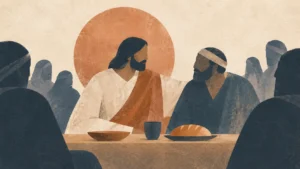
The tax collector went home justified because he humbled himself, admitted he was a sinner and appealed to God for mercy. The Pharisee trusted in his own righteousness and used his prayer to compare himself favourably with others. Jesus’ verdict reverses what someone might expect from their reputations. The parable asks us to examine whether we are relying on our own record or acknowledging our need for God’s mercy.
Luke 18:14
22 mins
Why Was the Tax Collector Justified?
Why did the tax collector go home justified in Luke 18:9–14? See what his plea for mercy reveals about being made right with God.
Message Summary
Q&A
Questions answered in this gospel message
Watch short video excerpts addressing some of the core questions from this message.
-

Question
01
Why did the tax collector go home justified in Luke 18?
Key Answer
-

Question
02
Can being a good person get you to heaven?
Key Answer
The sermon answers that a good record cannot make us right with God. The tax collector comes with nothing to offer and asks for mercy. The speaker says that the sacrifice of Jesus Christ is what pleases God. Paul illustrates the same point. He counted the religious credentials he once relied on as loss and rested his confidence in the Son of God, who loved him and gave Himself for him.
Full Sermon Transcript
The Pharisee and the Tax Collector
We’ll read a parable that the Lord Jesus told. Before we read it, I want you to think as we read, because there will be two men in this story. Which of the two men was full of himself, and which of the two men was empty of self, or empty of himself? So think about these things as we read in verse 9. “And He,” that’s the Lord Jesus, “spoke this parable to some who trusted in themselves that they were righteous and despised others.
“Two men went up to the temple to pray, one a Pharisee and the other a tax collector. “The Pharisee stood and prayed thus with himself, ‘God, I thank You that I am not like other men, extortioners, unjust, adulterers, or even as this tax collector. And he says, ‘I fast twice a week. I give tithes of all that I possess.’”
Verse 13, we read of the tax collector, “standing afar off, would not so much as raise his eyes to heaven, but beat his breast, saying, ‘God, be merciful to me, a sinner!’”
And in verse 14, the Lord gives the conclusion of the story. “I tell you, this man,” that’s the tax collector, “this man went down to his house justified rather than the other. For everyone who exalts himself will be humbled, and he who humbles himself will be exalted.”
So which of these two men was full of himself, and which was empty of self? And really, the question needs to be asked of you tonight. Because the stories and the parables that the Lord Jesus taught were really meant for self-reflection. So when you think of yourself, and when I think of myself, am I full, or am I empty? Am I full of myself, or am I empty of myself?
Because the Lord Jesus says at the end that he who exalts himself, those who are, we could say, full of themselves, God says these people will be humbled. But on the other hand, those who humble themselves, those who empty themselves of self, God says they will be exalted.
What We See in Others and in Ourselves
You know, God puts all of mankind on the same plane, on the same level. And we could say that there is not a single person in this meeting tonight who is any better than the person sitting right next to you. There’s no one that is better than another. I’m not better than you, and you’re not worse than me. God puts all of mankind on the same level.
You know, there’s an interesting verse in Scripture that says, “As in water face answers to face, so the heart of man to man.”
You say, “What does that mean?” Well, it means simply this. How do I know what I look like physically? God says simply, if you were to look in a calm or still pool of water, and perhaps you’d have appropriate lighting, you would see a reflection of yourself. And it would be exactly as you are. It wouldn’t be exaggerated. It would be just the way you are. You couldn’t look at yourself in a reflective pool and say, “That’s not me.” No, you would have to agree, “This is me. What I’m seeing is exactly as I am.” That’s on the physical sphere.
But how can I know what I am like morally? Is there such a mirror I can compare myself to? And we thought in past nights about the law. That’s one mirror, the Ten Commandments, that we can look at and compare ourselves to and see how far we’ve fallen. There’s also the Word of God, which is clearly a mirror in which we can see how God sees us.
But there’s also one that perhaps we’re more familiar with. And that’s looking at other people. And we can look at other people and say, “Well, you see what the people over there are doing? You see all the evil that they’re doing? You see all the blasphemous things that they’re saying? The vile joking and the inappropriate things that they do? And the injustice and so forth? You say, oh, these people. These people are tremendously wicked.”
Well, God says, as you look at someone, and as you might see something of revelation of their hearts and what they’re doing, God says other people’s hearts actually reflect something of our own heart. Because the truth is that we’re not different one from the other. We look different, perhaps. We may come from different backgrounds, speak different languages, have different jobs, employments. But we’re all cut from the same cloth, as it’s often been said. We’ve all been plagued by that fallen nature. And what’s neat about this example is it’s so much easier, isn’t it, to look at others and think that we’re so much better, and to kind of put people down.
God says, what you see in others is actually what’s inside of you. There’s the same potential in my own heart. In my own heart. And so God sees all of us on the same plane.
He says, actually, of all people, “All have sinned.” Without exception. “All have sinned and come short of the glory of God.” But how different from man. If God sees everyone the same, man, as I’ve just said, sometimes finds it easy to see differences. Differences that are not there.
The Pharisee’s Confidence in Himself
We think of this man and this story that the Lord Jesus told. And what’s interesting about this parable is that He gives us the very reason why He tells us this parable, why He tells us this story. And He says, the reason why I’m about to tell you this story about two men is because there’s some in the audience that actually think that they are righteous, or they might think that they are better than others. They think that they’re on their way to heaven. And really, they despise others.
And He gives the example of two men who go to the temple to pray. One is a Pharisee, that is, a religious leader, the strictest sect of Judaism. They prided themselves in their strict adherence to the Word of God, apparently, and in knowing the Scriptures. And they dressed nicely. And they said long prayers. And they even went to widows’ houses to help them. Talk about that in a moment.
But this man who is a Pharisee, a religious leader, God reveals his prayer. And he says that he is praying within himself. and he’s saying, “God, I…” The first thing he says is, “I thank You that I am not like other men.” There’s someone here, and that perhaps echoes your thinking. “God, I’m thankful that I’m not as other people are. I’m thankful that I’m an outstanding, upright, law-abiding citizen. I’m thankful that I’m not like the others who do terrible things.” Well, that’s how this man prayed.
And he says, “Well, I’m not like the extortioners. And I’m not like those that are unjust and the adulterers. I would never do that.” Adultery. Some might think, “Well, I’m not even married to begin with.” Well, the Lord Jesus said, if you even look at a woman to lust after her, you’ve committed adultery in your heart. In your heart.
So I think it’s clear to say that this man, this Pharisee, was actually full of himself. He took much comfort in the things that he didn’t do and in the things that he did do. He says, “I fast twice a week.” That’s commendable. He says, “I give tithes of all that I possess.” You say, wow, what a man.
And if you were to do a survey and ask people, which of these two men is right with God? A religious man who has his life in order and looks well and does all these things. Is he on his way to heaven? Or what about this tax collector, who really demands from people more than is required and keeps it for himself, and becomes very rich, who’s considered a thief, who’s considered to be the filth of the earth, hated by the people? People would be quick to say, well, surely it must be the religious man that’s on his way to heaven. I mean, what more is required for someone to go to heaven than to be a good person?
How Pride Keeps Us From Seeing Our Need
Well, you know, actually being full of ourselves is really masquerading. It’s hiding pride, isn’t it? Self-centeredness. Self-confidence. Self-sufficiency. Self-reliance. That’s all pride. It’s all pride.
And pride is a serious sin. You know, it’s very subtle because it’s not something perhaps that we can see. It’s not something that we usually boast about. We’re quick to boast about many things such as this man, the Pharisee. But I’ve never heard yet in my life someone say, “Well, I am so proud of myself.” We wouldn’t say that. We wouldn’t boast about being proud.
If we’re all honest, we all have pride within us. And pride is not something that God celebrates. It’s not a virtue. Pride is actually something that God condemns. There are many people that will miss out on heaven. They’ll die and face God’s judgment. Not because they were religious, because they went to church, or because they did this and that. But because they were proud. Because they were proud. Because they were relying upon themselves to go to heaven. They failed to see that, really, before God, all these things account for nothing.
You know, the scripture says, he who exalts himself, the one who is proud, the one who is puffed up, the one who thinks he’s doing well for himself. God says, that person, if there’s not a moment in his life where he humbles himself before God, God says, that person will be humbled. Will be humbled in eternity. When he faces the judgment for his own sins. But on the other hand, him who humbles himself here and now, that person will be exalted.
So pride is actually having a too high of opinion of oneself. And actually having a low opinion of God. The Bible says that “God resists the proud, but gives grace to the humble.” And if God resists the proud, I think it can be said that the proud also resist God.
Perhaps the proud, they resist the pronging of the Word of God. Maybe you have felt its little arrow, perhaps pronging you in your heart, in your conscience. God is speaking to you. God has been speaking to you. You’re just too proud. You’re just resisting. And you’re just holding on to yourself. Just holding on to yourself.
Those who are full of themselves, they don’t need a saviour. Did this Pharisee need anyone? Did he need anything? He was self-sufficient. God says such people don’t go to heaven. Blinded by self to see the Saviour.
The Tax Collector’s Plea for Mercy
I hope that tonight, if you’ve never taken the humble place, that tonight, even without going anywhere, this is something that you can do even in your chair, in the privacy and quietness of your own heart. To humble yourself before God. To be emptied of self.
Because this is what the tax collector did. It’s not that one was better than the other. In fact, the Pharisee who thought he was so much better, God knew. But most of them actually were hypocrites. Oh yeah, they said long prayers, but it was all to be heard. Oh yes, they visited the widows. How kind of them. But they were devouring widows’ houses. They were taking advantage of widows just to get their money. Oh, they looked good externally. But their heart was just as rotten as anybody else’s heart.
But you know, this publican, this tax collector, I don’t know how he was before. Maybe at one point he was proud to be a tax collector and just glad to be able to pocket a lot of money. But here he’s a totally different man. And really the antidote or the remedy to being full of oneself is really to humble oneself. It’s humility. And that’s what this man did.
He didn’t speak about himself. He didn’t say any great things that he had done. He had nothing to show forth. He had nothing to show God.
What Christ Brought to God
As we sang together, “Nothing in my hand I bring.” There’s somebody here, and you keep trying to bring something to God, trying to bring something sort of as a, you might say, a sacrifice to God. “God, will this please You at last? Have I done enough? Are my hands full enough?” They could be filled with all sorts of things. They could never be enough.
It’s not what we bring to God that can please God. It’s really the offering or the sacrifice of the Lord Jesus. And that alone pleases God. That’s why the Lord Jesus went to the cross. And He’s the one who humbled Himself to such an extent. Left the glories of heaven. He said He humbled Himself and He became as a servant. Think about it. The Creator. The Almighty. Became a man. A servant. He’s the one who would wash the disciples’ feet. God was willing to humble Himself to such an extent.
And yet we ourselves, often so full of self, we won’t even bow the knee. Won’t even bow the heart. We’re too proud.
But this man had nothing to show. Nothing in his hand he brought. He could just smite his breast and say, “Oh God, be merciful to me, a sinner.” Has that ever been the echo of your heart?
What Paul Counted as Loss
I think of men such as Paul. Paul also was a Pharisee at one point. And he was also full of self, full of himself. He was relying upon himself to get himself to heaven. Some of his credentials don’t mean much to us because they have a strong Jewish background. But nonetheless, he says, “I was circumcised the eighth day.” Exactly according to the law. Not the seventh, not the ninth. The eighth day. He said, “I’m of the stock of Israel. I am a Hebrew of Hebrews.” He says, concerning the law, that he was blameless. Concerning zeal, he persecuted the church. He thought he was doing a good thing. Oh, he believed in God. He believed there was a creator.
But there was a time even Paul, the great apostle Paul, as he later became, had to empty himself. All these things that he was once holding on to, his religion, his sincerity, his zeal, his knowledge. One time he said, “All these things I count but loss.” Paul realized all these things are futile. And he said, “That I might win Christ.” Not by anything that he has done, but by letting go of self. Now he could, as it were, embrace the Saviour.
Paul was saved. And Paul’s foundation, his sure foundation to get himself to heaven. And Paul knew that he was heaven bound. Paul knew that there was a place reserved for him in heaven. And he said, “It’s not because of anything I’ve done. It’s not because of anything I’ve brought to God. It’s only because the Son of God loved me and gave Himself for me.” Empty of self. What about you tonight?
Must I Come the Same Way?
You know, in the mid-1700s, thereabouts, there was a man, able preacher, John Wesley. And he was preaching as his custom was, and as it was customary in those days, to preach in public. And there he was in Great Britain preaching. And there was this posh lady, this well-off, wealthy woman. And she was riding in a horse and carriage and being brought to wherever she had to go. And she saw this crowd gathered and this man speaking. And she said to halt the horses and wanted to hear what was going on. And she stepped out and came and listened to some of John Wesley’s words, which really he was preaching the gospel.
And there came a moment where, to her horror, she saw her driver, her servant, prostrate upon the floor, convicted by the message of the gospel. Almost like this tax collector, just beating his chest, saying, “Oh God, be merciful to me, a sinner.” And this wealthy woman asked the preacher, she said, “Must I come the same way?” And the answer came. John said, “Oh, yes, madam. We all must come the same way.”
And her final answer came. “Well, if that’s the case, then I will never be saved.” She was not willing to take the lower place. She was not willing to humble herself.
What about you tonight? God says very clearly words by which he expects you to act upon. He says, “For everyone who exalts himself will be humbled.” And that will not be a pleasant experience. But God says those who humble themselves will be exalted.
I pray that this will be your experience tonight, that you’ll humble yourself, empty yourself of your own self, and receive the Lord Jesus as your Saviour.
Scripture quotations outside the historical sermon transcript use the New King James Version®. Copyright © 1982 by Thomas Nelson. Used by permission. All rights reserved. The transcript preserves the wording used by the speaker.
Key scripture
I tell you, this man went down to his house justified rather than the other; for everyone who exalts himself will be humbled, and he who humbles himself will be exalted.”
Luke 18:14
Related Messages


Want to Learn More About Salvation?
If you’d like to understand how the Bible explains sin, forgiveness, faith, and salvation through Jesus Christ, explore the resources below. You can also contact us if you would like to speak with someone from Ottawa Gospel Hall.